Showing posts with label Book Review. Show all posts

Monday, September 24, 2012

The Birds, the Bees, and Boys: Teaching Your Boys About Sex -- Part 3, a Book Review

     In  The Birds, the Bees, and Boys: Teaching Your Boys About Sex Part 1, I discussed how to form and model a healthy, Biblical view of sexuality, tips on talking about sex, and other topics leading up to puberty.  Then, in The Birds, the Bees, and Boys: Teaching Your Boys About Sex Part 2, I explained the "nitty-gritty" of puberty:  physical and emotional changes, the importance of fathers, and the continual need for a mother's love.  Finally, I want to share a book that may help you as you introduce your son to how he is changing.
     When our oldest was still pretty young, my husband and I decided we needed a good book to introduce our son to puberty and sex.  I asked other mothers of boys, did internet searches, and bought a few, but I didn't find one that my husband and I liked.  Then, by God's providence, I came across this one, and we have been very pleased with it.


How You Are Changing:  For Boys Ages 10-12
Book 3 of the Learning about Sex Series for Boys
from text originally written by Jane Graver, 
updated and revised

     This book is a gentle introduction to puberty that goes into, in my opinion, just the right amount of detail.  The book is filled with Scripture, has a prayer at the end of each chapter, and encourages young men to embrace themselves as creations of God.  Other books show pictures that would make most boys uncomfortable.  For example, in Before I Was Born (for ages 5 to 8) by Carolyn Nystrom, published by NavPress, there is a somewhat realistic drawing of a mother giving birth.  I realize that some families choose to have older children present during childbirth, but for young boys who have not had this experience, this picture (see below) and others like it could make them feel uncomfortable.  
From God's Design for Sex Series, Before I Was Born,  Book 2, Ages 5 -8, by Carolyn Nystrom, NavPres.
This drawing and others like it would make a young boy going through puberty uncomfortable.  
Notice that the recommended age range for this book is 5-8.  


In contrast, How You Are Changing uses more ink-type drawings that do not have a realistic feel but are instructive.  
From Learning About Sex for the Christian family, How You Are Changing, Book 3, For Boys ages 10-12, Concordia Publishing House. The entire subject will make boys uncomfortable, but the pictures in this book offer enough information to be instructive without the realism that impedes the point.

    How You Are Changing is only 56 pages long and contains 8 chapters.  My husband asked my son to read about a chapter a week when he was 12 years old.  Then they would discuss the chapter together at McDonald's or at home when little brother was in bed.  The age range for this book is 10-12; however, I don't think he would've been ready at age 10.  Age 11 and a half probably would have been fine.  However, your son may be different.  If he is in public school and has heard some things in the locker room or has friends who have shared with him some juicy tidbits, then it may be time to go ahead and read the book together.
     The tone of the book is light yet serious.  After reading it, your son should come away feeling like he knows what to expect and that it's new and different but part of God's plan.  This series also has a set of books just for girls.
     Below is a brief summary of each chapter.  

Chapter 1.  You Are Wonderful
This chapter is about how God created your son to be male.  It goes on to discuss how girls and boys are different physically -- but also in other ways, such as emotionally.  It emphasizes that no sex, male or female, is better than another.  It encourages your son to remember:  You are special, you have talents, and God loves you very much.

Chapter 2.  Male + Female + God's Gift of Life = BABY
Using appropriate pictures, this chapter show how the bodies and reproductive organs of men and women are physically different. Then, the chapter discusses how a brand new person is made:  "When a sperm cell from your father met and united with an egg cell in one of your mother's fallopian tubes, your life began.  In that instant, the question of whether you were going to be a boy or a girl was decided.  ....The egg cell and the sperm cell did more than just stick together.  Following God's design, the two cells changed into one new cell -- the beginning of a brand-new person!  That tiny life has all the DNA factors that make a person unique -- that make you you." (p. 18)
     Later the chapter discusses family as a gift from God and the subject of difficult families, followed by God's plan for families.  The book describes intercourse on page 22:  "At times, a husband and wife will want to express their love for each other in a special way called sexual intercourse.  At those times, they will go off by themselves.  They will hug and kiss each other and touch each other all over.  The husband's penis will become firm and hard, able to fit inside his wife's vagina.  This is a private act between husband and wife."  Finally, the book discusses how it is God's plan for only a husband and a wife to "make love in this way" (p. 23)

Chapter 3.  God Took Care of You ... Right from the Beginning
This chapter explains how a baby starts out smaller than a dot and then miraculously becomes a baby.  Later, the chapter addresses where babies come out  "...the vagina and vulva stretched to let you come out between your mother's legs."  (p. 28)  

Chapter 4.  You've Grown!
Chapter 4 uses a dialogue format and answers questions and concerns such as:  "Some kids think sex is dirty":  "As we said, some people have mixed-up and sinful ideas about sex.  They might be embarrassed by using the right words for penis and vagina, for instance, so they use slang words instead.  Or they get their information from jokes and made-up stories instead of from an adult they can trust, like a parent.  We are reminded in Matthew 15:19 (ESV) that 'out of the heart come evil thoughts...sexual immorality'"  (p. 36).  Other concerns are discussed such as being embarrassed to talk with parents about sex and wanting to be alone. 

Chapter 5.  Next Step:  Adolescence
This section discusses "How Boys Change" -- weight, height, hair, testicle growth, erections, voice changes, wet dreams, etc. in under 2 pages, then moves on to "How Girls Change," about a page in length and covers period, menstruation, breasts, etc.

Chapter 6.  Am I Normal?
This chapter addresses boys of different shapes and sizes, circumcision, different rates of growth, and weight gain.

Chapter 7.  Feeling Good about Your Sexuality
Written as a dialogue between a teen boy and the author, this chapter broaches such subjects as inappropriate tv shows, watching girls, sexual abuse, smoking, drugs, and alcohol.

Chapter 8.  It's Great to Be Alive!
This final chapter is an encouragement to young, growing boys that it is special to be human and that God has a special love for his human creations.  Furthermore, the author describes "God's good gift of sex" as a means to bring other wonderful children into the world.  "God's love can make sex a wonderful part of your love for another person.  Guided by Him, you can choose a wife who will share your life.  The love you have for each other will be extra-special if God lives in both of you."  (p. 55)

     Overall, this book is an encouraging, unabashedly Christian discussion of male sexuality written in a light, easy-going manner.  I highly recommend it.

Wednesday, August 15, 2012

Who's the Hero? Thoughts on the Hunger Games Series

*****SPOILER ALERT*****SPOILER ALERT*****SPOILER ALERT*****SPOILER ALERT*****  
Do not continue reading 
if you plan to read the Hunger Game books or if you have not finished the books!


     I just finished the Hunger Games series last night.  I closed the final book and tried to name the emotion I felt.  Satisfied.  I was satisfied.  
     Suzanne Collins is an incredible writer who created a page-turner with surprises so shocking that I actually gasped out loud once or twice.  However, she is not writing from a Christian point-of-view and that makes working out the tension between good and evil (sin) difficult.  She writes of a society gone terribly wrong with no Redeemer in sight.  That makes swallowing the story line and facing the incredible evil a problem, and although Katniss sparks the revolution, she is NOT the hero.
     Although Katniss is willing to die for her sister, her positive qualities are limited.  She feels compassion towards the Avox she did not save, and Rue, the little girl who reminded her of her sister.  Although she is smart, intuitive, resourceful, brave, and fierce, she is also quick to anger, selfish, distrustful, and suspicious, and she knows it. The girl on fire, fueled by hatred and revenge, becomes a murderer, a survivalist, a manipulator, yet her behavior is completely understandable considering she almost starved to death when 11, watched her mother descend into deep depression, broke the law daily to save her family, and acted as an adult simply to survive the cruel society into which she was born.  The girl's got baggage, but it's important to remember, she is a girl, and she is a survivor.
     Gale is no better.  He starts out angry and then becomes vengeful, creating traps that play on human sympathies in order to kill others.  Even Katniss is uncomfortable with his methods.
     Peeta, on the other hand, is the only one in the series who seems to have a grasp of what the society has done and is capable of doing to ruin all that is good about humanity.  In book one he says, "'I don't want them to change me in there.  Turn me into some kind of monster that I'm not.'"  Despite President Snow's "hijacking," it is Peeta who is able to NOT become that monster.  When even Katniss stoops so low as to  call for a Hunger Games for the children of the Capital, Peeta, arguing with Haymitch, is appalled at "the atrocity he could become party to."  (Book 3).  While Gale is the one who brings Katniss the arrow to assassinate Snow, Peeta is the one who takes the nightlock from her.  
     Peeta.  I closed the book, and I was satisfied because of Peeta.  In the end, he redeems her.  He loves her unquestionably, faithfully, and unconditionally.  He never gives up on her.  He cares for her and those around him.  He does what is right, what is good.  He sees beauty in the darkness.  He never kills anyone in the book unless by accident, even when brainwashed.  Peeta.  It sounds like Peter, to me, and if so, it means "rock."  Peeta is a rock -- unchanging, steadfast.  Peeta is hope.  Peeta does not become the monster, never crosses that line, redeems Katniss with his love, and in the end, redeems the humanity that has become reduced to a Darwinian world of the strongest and most deadly survive.  Peeta makes Katniss and the world around him a better place, and that is why I am satisfied.


     For a different opinion, see Why the Hunger Games is Flawed to Its Core.  I respect N.D. Wilson very much, and I've read all his books.  However, I don't agree that Peeta is a wimpy, passive guy.  He's a teenager trapped in a hopeless system.  Yes, I would have loved it if, in the first book, Katniss cut out her arm tracker and saved the other tributes from the bad tributes, but then what?  The Gamemakers could have killed her off quickly, and then the books would be over.  Finally, I disagree that revolutions aren't started by small things like berries.  In that moment, she decided it was better to kill herself and Peeta than to let them win, to force her to do the unthinkable -- kill her friend.  That was a huge act of courage that could indeed spark a revolution if such a terrible world existed and that entire world was watching live, but that is just my opinion.  

NOTE:  Considering the darkness of the books, I think parents need to be very wary of allowing children younger than 13 to read them.  By the third book, the author is describing the tributes being used as sex slaves, and we must remember -- the tributes are children.  Alcohol and drug abuse, brutality, murder, evil -- all of this is dark and takes maturity to work through.


Monday, March 5, 2012

Apologia Elementary/Middle School Science -- Strong Science for Ages 6-12

     Both of my boys love science.  When young, we would check out lots of books from our local library on a wide range of science topics.  However, we found that many science textbooks for the elementary and early middle school ages are weak and boring.  Fortunately, Apologia, well-known in the high school science market, now offers a science curriculum for elementary and middles schoolers that boasts strong science with a viewpoint that points to the Creator.  
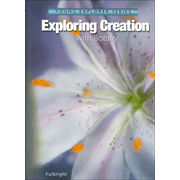
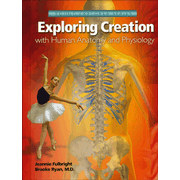
     Jeannie K. Fulbright has authored six excellent books which delve into zoology, botany, astronomy, and human anatomy.  Each book contains 13 or 14 chapters and can be used for ages 6-12, with modifications, of course.  Notebooking journals are available for purchase, or you can print out pages from each course's free website.  The textbooks are full of beautiful and interesting illustrations, activities, hands-on assignments, experiments, projects, and more.  I highly recommend them because they are strong scientifically and yet Christian in viewpoint.
     Below is a list of the Apologia books and how we have or will use them.


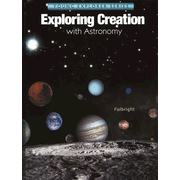
Exploring Creation with Astronomy -- When my oldest studied astronomy in 2nd or 3rd grade, I read this to him, and he created a lapbook.  We used The Usborne First Encyclopedia of Space and The World of Space by Dinah Zike and Susan Simpson in conjunction with this book.


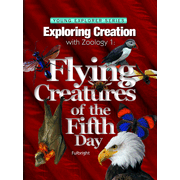
Flying creatures of the Fifth Day:  Exploring Creation with Zoology 1    After completing the Zoology 3 book in our co-op, my son read this book and the Zoology 2 book on his own at home in his 7th grade year.  He finished both books in about two and a half months.  We did not do the activities, and I did not test him.  He read for pure love of science.


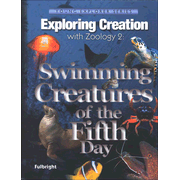
Swimming Creatures of the Fifth Day:  Exploring Creation with Zoology 2  See above.


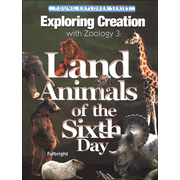
Land Animals of the Sixth Day:  Exploring Creation with Zoology 3   This book was the core textbook for the zoology class my son took at our co-op his 6th grade year.  They covered the book in a school year, covering 1 chapter every two weeks.  In my opinion, for a 6th grader, this book can be covered easily in one semester.


Exploring Creation with Botany  This semester, I started this book with both boys (3rd and 7th grades), and I purchased the notebooking journals that accompany the textbook.  I read a section aloud to the boys, and we work on the activities together.  Due to a busy spring, we are working slowly.  However, we built the suggested light hut and have lots of little plants growing inside waiting to be transplanted outside.  If I can ever remember to buy the appropriate flower, we will do the flower dissection!


Exploring Creation with Human Anatomy and Physiology  
I hope to do this book next with both boys, right after finishing botany.  I purchased the Anatomy Notebooking Journal and the Junior Anatomy Notebooking Journal.  Had I known that the Junior version had coloring pages added in, I would not have purchased it.  If you child enjoys coloring (my third grader does not), then your child may like it.  


****NOTE:  For the month of March 2012, Apologia Elementary Science is 30% off at CBD.  This is a GREAT deal.  

Thursday, February 9, 2012

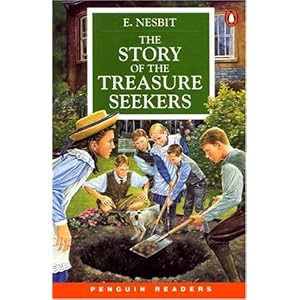
The Story of the Treasure Seekers by E. Nesbit -- A Great Read Aloud!

     "This is the story of the different ways we looked for treasure, and I think when you have read it you will see that we were not lazy about the looking."   From the first sentence of the first page, The Story of the Treasure Seekers:  Being the adventures of the Bastable children in search of a fortune, by E. Nesbit gets right to the point, and the adventures that follow are as irresistible as the Bastable children themselves.
     Originally published as short stories in magazines and put into book form in 1899, The Story of the Treasure Seekers is the delightful tale of the six Bastable children, Dora, Oswald, Dicky, Alice, Noel, and Horace Octavius (H.O.)  After their mother dies ("and if you think we don't care because I don't tell you much about her you only show that you do not understand people at all") and their father also falls ill, "his business-partner went to Spain -- and there was never much money afterwards."  As creditors start calling and the children must leave school because father can no longer afford it, they decide they must do something to restore their fallen fortunes.  Each child comes up with a plan, and, well, their plans are hysterical.  Oswald suggests stopping "people on Blackheath -- with crepe masks and horse-pistols -- and say 'Your money or your life!  Resistance is useless, we are armed to the teeth.'"  Other ideas include rescuing an old gentleman in deadly peril, using a divining-rod to search for gold, becoming bandits, finding a princess and marrying her, becoming detectives, and digging for treasure.  Fortunately for us but not so much for their father, they actually carry out their plans and much hilarity ensues.
     Written over 100 years ago, this book has never lost its appeal to readers young and old alike.  My boys were ages 11 and 8 when I read it, and we all laughed from beginning to end.  I recommend it as a read aloud because it's great fun for the entire family and because there are some vocabulary words that are difficult.  It was written in the 1890s, afterall.
     I leave you with a poem, written by Noel.  If you have a child who is sad, here in Houston, when the dead June bugs litter the sidewalks, then you'll love this poem.
     
Lines on a Dead Black Beetle that was poisoned
Beetle how I weep to see
   Thee lying on thy poor back!
It is so very sad indeed.
   You were so shiny and black.
I wish you were alive again
But Eliza says wishing it is nonsense and a shame.


     "It was a very good beetle poison, and there were hundreds of them lying dead -- but Noel only wrote a piece of poetry for one of them ...and the worst of it was he didn't know which one he'd written it to -- so Alice couldn't bury the beetle and put the lines on its grave, though she wanted to very much."     (Chapter 4)


Thanks so much, Holly S., for recommending this book!  We LOVED it!

Tuesday, February 7, 2012

100 Cupboards Trilogy by N.D. Wilson -- EXCELLENT!

     After reading N.D. Wilson's first book, Leepike Ridge, my oldest son and I sped through his three novels in the 100 Cupboards Trilogy:  The 100 Cupboards, Dandelion Fire, and The Chestnut King.  I started reading first, but by the third book, my son passed me and eagerly waited for me to finish so we could talk about the ending.  Each book grew longer (320, 480, 512 pages), but neither of us wanted to put them down.  When he finished reading at night, I asked him to leave it on the floor by his bed so I could snag it.  They were just that good.
     After his parents are kidnapped, Henry York, age 12, ends up in a town called Henry, Kansas, living with his Uncle Frank and Aunt Dotty and their three children, Penelope, Anastasia, and Henrietta, whom they also called Henry until Henry moved in with them.  One night, he finds plaster in his hair and using the knife Uncle Frank had bought for him, picks all the plaster off the wall to find 100 cupboards of all shapes and sizes, and thus begins his adventures.
     So Henry, a young, unlikely hero, who throws up when scared and whose parents made him wear a helmet to P.E. class, never told him he was adopted, and continually left him with nannies and in boarding school, finds 100 new worlds and a surprising heritage, learns to be brave, discovers baseball, family, and friendship, and, by the end, is given an impossible, Frodo-like, task.  It's a classic tale of good vs. evil, with well-developed, unique, irresistible characters and some pretty rotten, evil ones, too.  The plot keeps you guessing, and the writing is pleasantly refreshing, unique, and unexpected.   You'll find yourself holding your breath, cheering for Henry and his family, and hoping he doesn't lose everything he has just gained.  There are funny parts, intense battle scenes and fights, and loving and tender moments.  Unlike some book series which end badly as if the author didn't know how to wrap it up, this book ties up beautifully at the end, leaving you satisfied.  
     My favorite part, though, is that the boys are young, but they are loyal, keep their word, face fear, and grow as young men.  Henrietta starts out as an impulsive, sneaky girl, stubborn, and obsessively curious and turns into a brave, still-stubborn, yet strong young woman by the end.
     As a fantasy series, this is one of my favorites; it may not be The Lord of the Rings or The Chronicles of Narnia, but it is very close.  Wilson's first novel, Leepike Ridge is good, but his 100 Cupboards Trilogy is incredible.  His next series, Ashtown Burials, is out, and we can't wait to read the first book!


     N.D. Wilson wrote an article for DesiringGod.com called "Stories Are Soul Food: Don't Let Your Children Hunger" on why our children need good strong stories of good and evil, and even magic.  I wrote earlier about Wilson's father, Doug Wilson, author of Future Men, here.  (It was quite by accident and a cool coincidence that I found out that N.D. Wilson and Doug Wilson were thus related!)   For a three-chapter-sample of 100 Cupboards, click here.
     Finally, I leave you with two quotes from the last book, The Chestnut King; quotes which reveal why both my son and I loved this series.

     "Frank opened his mouth.  He wanted to make her promises, to tell her lies, but he couldn't.  Instead, he leaned his face over into her wet, straggling hair.  
     "'Dots,' he whispered.  'You're my life, and I've loved it.'  He drew in her smell, and she leaned her head against his lips.  'Every kiss, every dirty look, every night we slept between clean, starchy sheets, and every night we didn't.  Every nag and needle and nudge.'
     "He sat up.  'Your peaches,' he said.  'And your applesauce.  How many pies do you think I've eaten in my life?'  He looked down at her.  'Not enough.'  He smiled.  'If we get out of this, there needs to be more pie.  That's all the complaining I've got.'"  -- Frank to Dotty when it seems they will both die soon, The Chestnut King


     "Let evil hear the pounding of our feet!  Let evil hear our drumming and our chanting songs of war.  Let evil fear us!  Let evil flee!  In any world, may dark things know our names and fear.  May their vile skins creep and shiver at every mention of the faeren.  Let the night flee before the dawn and the darkness crowd into the shadows.  We march to war!"  -- King Nudd, The Chestnut King


Note for parents:  I recommend this series for children ages 10 and up, maybe older, depending on the sensitivity of your child.  My son is 12.  The books contain fighting and other violence, bloodshed, death, some very dark moments, and magic.  The 2nd book uses the profanity d**n. 

Thursday, January 19, 2012

Mrs. Piggle-Wiggle -- A Great Read Aloud

     When I first began reading Mrs. Piggle Wiggle by Betty MacDonald aloud to my two boys, I wasn't sure what to expect.  We quickly found ourselves chuckling, giggling, and laughing out loud.
     Mrs. Piggle-Wiggle is an older lady who lives in an upside down house with "no family at all."  However, she quickly befriends all the neighborhood children with her stories, games, and fun!  She allows the kids to dig for treasure in her backyard, comb her hair, and make a mess baking cookies in her kitchen.  The real laughs begin, though, when Mrs. Piggle-Wiggle begins to give the neighborhood parents "wonderful cures" to help them correct their children's poor behavior.  Her cures include The Won't-Pick-Up-Toys Cure, The Answer-Backer Cure, The Never-Want-To-Go-To-Bedders Cure, The Fighter-Quarrelers Cure, and more.  All of these cures are hilarious, but when we got to The Radish Cure to help little Patsy learn to take a bath, I laughed so hard I cried!
     Mrs. Piggle-Wiggle is eight short but wildly-entertaining chapters long and highly recommended by the Mullin family!  


Note:  If you don't read aloud books as a family, turn off the television and try reading this book together.  It's great, cheap, memorable family fun!  

Tuesday, January 10, 2012

The Mystery of History by Linda Lacour Hobar

     When I was in high school, every history teacher I had wrote copious notes on the board which we were required to write in our notebooks, word for word, for a test grade.  History was boring.
     When I began homeschooling, I decided there must be more to this subject of history.  I'd heard others say they love history.  My husband loves history.  Surely, I must be missing something.
     Early on, I decided to teach history in chronological order because that made sense to me.  Teaching about the Pilgrims followed by the Mayans followed by the Greeks seems ... well, out of order and confusing.  Initially, I chose to use The Story of the World by Susan Wise Bauer.  My oldest son and I enjoyed the book and the activity book.  We checked out several recommended extra library books, made a Nubian costume, colored maps, and made all sorts of crafts.  We got through the first 10 chapters out of 42 in our first year. 
     During this time, people were beginning to talk of a new book called The Mystery of History and how wonderful it was, but I was content with The Story of the World.  After finishing volume 1, we began The Story of the World, Volume 2: The Middle Ages, but there was something missing.    I purchased a copy of The Mystery of History:  The Early Church and the Middle Ages and immediately switched. 
     The Mystery of History by Linda Hobar, like The Story of the World, is written in chronological order, is conversational, and has an activity guide.  However, The Story of the World is meant to be a secular text, and The Mystery of History is unabashedly Christian.  Once we came to the middle ages and the Reformation, understanding church history became necessary to understand any history of Europe at all. In Bauer's attempt to be secular, the history of the church and thus all of Europe at the time, was anemic.  Also, I felt that Bauer's writing in her first book was markedly better than that of her second book (and I hear that her third and fourth are worse) and that the historical events were not in a strict chronological order, which drove me crazy.  Finally, I believe The Mystery of History is more easily adapted for older students.
     In the "Letter to the Teacher," Hobar writes, "I think one of the easier ways to 'know God better and to make Him known' is to first know the stories of Him found in history and the Bible from the beginning to the end!  That to me is history.  I believe history is the story of God revealing Himself to mankind and that He did it most perfectly through the person of Jesus Christ.  For that reason, I call this course The Mystery of History, believing that the 'mystery' is the gospel of Jesus Christ."  I agree, wholeheartedly, which is why I love this series; it is strongly Christian and yet strongly academic.
     Some have complained that Hobar shares too many opinions and is too conversational, but my sons and I thoroughly enjoy her writing style.  They look forward to reading history every day.
     The book can be adapted for a variety of ages and has suggestions for doing so.  The activity book has an excellent list of literature or other books to accompany this curriculum, broken up into categories for older, middle, and younger kids.  There are tests, quizzes, activities, maps, and other fun ideas in the activity book as well.  Timeline figures are available from Homeschooling in the Woods to make a timeline, or you can make your own pictures.  We used the pre-made timeline figures for Volume 3, and I had my oldest make notecards with important points listed for each chapter.  My youngest listened to the chapter with his brother and to any additional books, fact or fiction, that we chose to read to go along with the chapter. 
     Currently, The Mystery of History Volume IV is not written, so we have taken a break from world history and begun studying United States history.  However, we anxiously await Hobar's next and last volume.

     Finally, I believe, God used The Mystery of History:  Volume III The Renaissance, Reformation, and Growth of Nations  to reveal Himself more fully to my youngest son.  In August 2011, we studied  Lesson 71 about  Blaise Pascal (1654).  Pascal was a brilliant man who invented the first calculator, came up with Pascal's Law and Pascal's Theorem, and refined the Theory of Probabilities.  However, unlike most history books, Hobar shares Pascal's testimony of how he trusted Christ as his Savior after losing control of his carriage and almost losing his life.  His life was radically transformed, and he dedicated the rest of his life to Christian causes.  It was during this lesson that Titus decided to trust Christ.  As Hobar says, "history is the story of God revealing Himself to mankind and that He did it most perfectly through the person of Jesus Christ."  Amen!
     Oh, and by the way, I love history now.  It's one of my favorites, as long as I'm not copying notes off a blackboard.