Showing posts with label Science. Show all posts

Thursday, October 4, 2012

What Is Man that You Are Mindful of Him? Astronomy Lessons

     This semester I have the privilege of teaching astronomy to 27 third through fifth graders.  The last time I taught astronomy was about 5 years ago to my oldest son.  Coming back to the subject so many years later does not dull the awe that I feel every time I study the heavens.

Psalm 8
O LORD, our Lord, how majestic is your name in all the earth! You have set your glory above the heavens.  From the lips of children and infants you have ordained praise because of your enemies, to silence the foe and the avenger.  When I consider your heavens, the work of your fingers, the moon and the stars, which you have set in place,  what is man that you are mindful of him, the son of man that you care for him?  You made him a little lower than the heavenly beings and crowned him with glory and honor.  You made him ruler over the works of your hands; you put everything under his feet:  all flocks and herds, and the beasts of the field,  the birds of the air, and the fish of the sea, all that swim the paths of the seas.  O LORD, our Lord, how majestic is your name in all the earth!    


"Swirls of gas and dust reside in this ethereal-looking region of star formation seen by NASA's Hubble Space Telescope. This majestic view, located in the Large Magellanic Cloud (LMC), reveals a region where low-mass, infant stars and their much more massive stellar neighbors reside. A shroud of blue haze gently lingers amid the stars."  NASA.gov

Our galaxy, the Milky Way, is just one of an infinite number of galaxies in the universe.


The Milky Way contains 200 - 400 billion stars.  
Our Sun is just one of those stars.
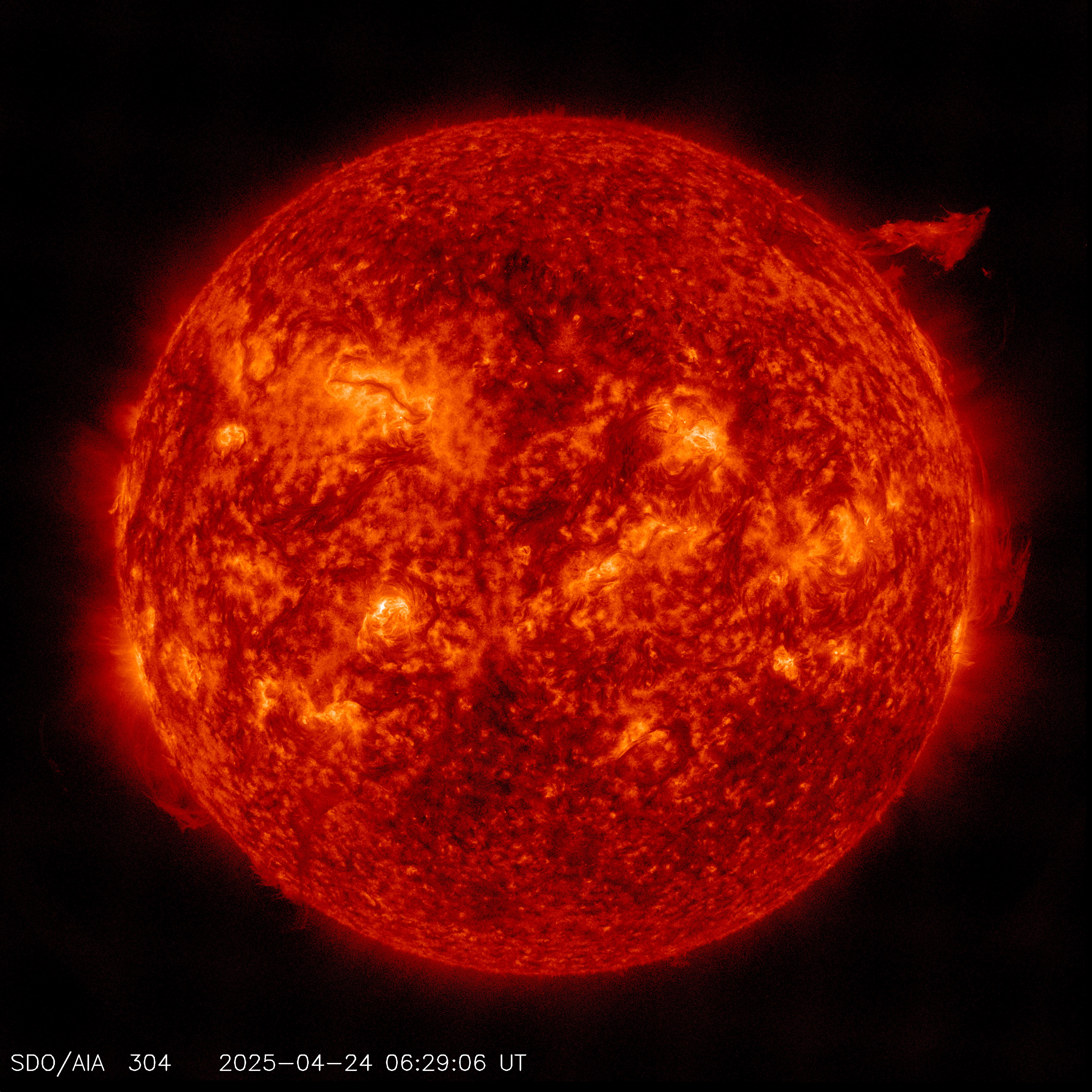


Our Sun is a medium-sized star.


One million of our Earth's would fit inside 
our medium-star-sized Sun.


When I consider your heavens, the work of your fingers, 
the moon and the stars, which you have set in place,  
what is man that you are mindful of him, 
the son of man that you care for him? 
Psalm 8:3-4

Yes, what is man that You are mindful of him?  
We are but tiny specks in the vast universe 
and yet God knows us, loves us, and sent His Son to die for us.  
Your name, O LORD, is truly majestic!


All photos from www.nasa.gov
Credit: NASA, ESA, and the Hubble Heritage Team (STScI/AURA)-ESA/Hubble Collaboration

Friday, August 17, 2012

The Wondrous Things of God: Life Cycle of the Monarch Butterfly

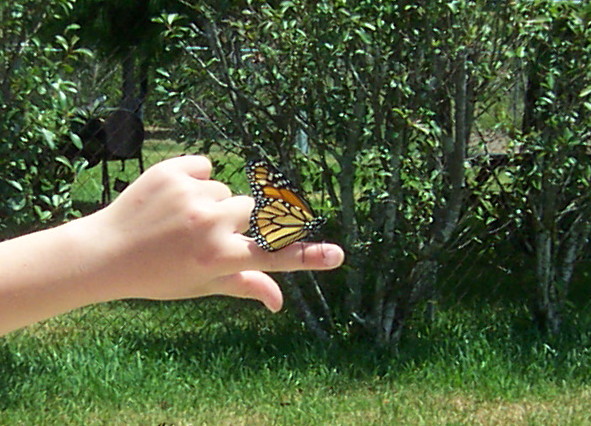
     There is something truly amazing about an egg the size of a pen point containing an itty-bitty caterpillar that will eventually become a monarch butterfly.  I never tire of watching the process and have multiple milkweed plants surrounding my house.  Only a majestic and wondrous God could come up with such an awesome process.  Really.  
     I have seen a caterpillar, early one morning, hanging upside down in his 'J,' transform into a chrysalis.  It's like his old body literally turns inside out, and in a matter of seconds, he is a wet, green, gold-flecked chrysalis.  In about 10 days, the chrysalis blackens, and then you can see the wings inside.  Finally, he pulls himself out, wet, dripping, and shriveled, but after a few more hours, he takes to the wind, a beautiful orange butterfly.  Amazing.  Beautiful.  Wonderful.  I never tire of it.


2 Corinthians 5:17
Therefore, if anyone is in Christ, he is a new creation.
The old has passed away; behold, the new has come.

Monday, June 11, 2012

Tasty Science: Homemade Vanilla Ice Cream in a Ziploc Bag

     Here is a FUN activity and lesson that I did a while back.  I'm sharing it with you to do with your children this summer -- along with some history and science!  The end result is yummy ice cream!


READ:  Should I Share My Ice Cream by Mo Willems


HISTORY:  No one knows when ice cream was invented.  About 3,000 years ago, the Chinese mixed rice, snow, and milk together to make a tasty treat.  In Persia, about 400 BC, people would pour grape juice on snow and eat it when it was hot outside.  The Emperor Nero had ice and snow brought to him in Rome to eat with fruit juice.  It seems that the Arabs were the first to use milk to make ice cream sweetened with sugar.  In the 10th century, many cities in the Arabic world such as Baghdad, Damascus, and Cairo produced ice cream with milk, cream, or yogurt and flavored it with rosewater, dried fruits, and nuts.
     Here in America, the British brought ice cream to the American colonies about 300 years ago, but only the wealthy could eat it because ice was very rare and expensive.  In the 1840s, Nancy Johnson from New Jersey invented a hand-cranked ice cream maker, and the rest is history!

THE SCIENCE of ICE CREAM:
How does it happen:
  • Milk can change from a liquid to a solid with the help of ice and salt.
  • It involves the exchange of heat.
  • Cold does not exist by itself. It is simply the absence of heat.
  • For example, a cold room is cold because some of its heat energy has escaped.
  • Heat energy goes from places with more heat energy to places with less.
  • The milk mixture has more heat energy than the salt and ice does.
  • Therefore, heat energy goes from the milk mixture to the ice and salt.
  • The milk mixture lost heat energy, which caused it to cool and freeze, eventually becoming ice cream, a solid.
  • The ice gained heat energy, which caused it to melt, eventually becoming salt water, a liquid.
  • When you add salt to the ice, it lowers the freezing point of the ice, so even more energy has to be absorbed from the environment in order for the ice to melt.  This makes the ice colder than it was before.
  • So the addition of salt lowers the freezing temperature, which causes the ice cream to freeze sooner.
  • If you do not add the salt, the mixture will get cold but only as cold as the ice – so it will be more like a thin milkshake.
TRY THIS:  Put ice and water in two cups.  Add salt or rock salt to one.  Stir.  Take the temperature of both.  Which is colder?

REVIEW of THE SCIENCE of ICE CREAM:
  • So….The ice cream mixture is about 32 degrees.
  • The salt-ice mixture is below 32 degress.
  • Heat flows from warmer to cooler objects, so the energy from the ice cream mixture flows to the salt-ice mixture.
  • The ice cream mixture gets colder, and the salt-ice mixture begins to melt.


MAKE ICE CREAM:

Materials:
Large gallon size ziploc/re-sealable bag
2 Quart sized ziploc/re-sealable bags
1 cup half and half
½ to ¾ teaspoon Vanilla
2 tablespoons Sugar
½ to ¾ cup Rock salt
Ice 


STEP 1. Carefully pour the half and half, vanilla and sugar into one of the small bags. Seal tightly, squeezing out as much air as possible.
STEP 2. Place the bag with the mixture inside the other small bag and seal it, leaving as little air as pos­sible.
STEP 3. Place the ice inside the one-gallon re-sealable bag.
STEP 4. Place the two small bags containing the mixture inside the larger bag with the ice. Make sure the ice surrounds the bags with the cream mixture.
STEP 5. Sprinkle the salt over the ice in the larger bag.
STEP 6. Seal the larger bag, letting as much air escape as possible.
STEP 7. Wear gloves or wrap bag in a towel.
STEP 8. Shake and massage the bag for approximately 15-20 minutes.  
STEP 9.  Remove small bags from the large bag, open, and eat!  (Be careful not to get salt in the ice cream.  You may want to rinse off the bag in the kitchen sink before opening it.)


SOURCES:  
*History of Ice Cream,  Wikipedia 
*Ice Cream:  The Full Scoop by Gail Gibbons
*http://www2.gi.alaska.edu/STEP/lessons_database/lessons/acmp/acmp_58_MeltingTheIce.pdf


Monday, March 5, 2012

Apologia Elementary/Middle School Science -- Strong Science for Ages 6-12

     Both of my boys love science.  When young, we would check out lots of books from our local library on a wide range of science topics.  However, we found that many science textbooks for the elementary and early middle school ages are weak and boring.  Fortunately, Apologia, well-known in the high school science market, now offers a science curriculum for elementary and middles schoolers that boasts strong science with a viewpoint that points to the Creator.  
     Jeannie K. Fulbright has authored six excellent books which delve into zoology, botany, astronomy, and human anatomy.  Each book contains 13 or 14 chapters and can be used for ages 6-12, with modifications, of course.  Notebooking journals are available for purchase, or you can print out pages from each course's free website.  The textbooks are full of beautiful and interesting illustrations, activities, hands-on assignments, experiments, projects, and more.  I highly recommend them because they are strong scientifically and yet Christian in viewpoint.
     Below is a list of the Apologia books and how we have or will use them.


Exploring Creation with Astronomy -- When my oldest studied astronomy in 2nd or 3rd grade, I read this to him, and he created a lapbook.  We used The Usborne First Encyclopedia of Space and The World of Space by Dinah Zike and Susan Simpson in conjunction with this book.


Flying creatures of the Fifth Day:  Exploring Creation with Zoology 1    After completing the Zoology 3 book in our co-op, my son read this book and the Zoology 2 book on his own at home in his 7th grade year.  He finished both books in about two and a half months.  We did not do the activities, and I did not test him.  He read for pure love of science.


Swimming Creatures of the Fifth Day:  Exploring Creation with Zoology 2  See above.


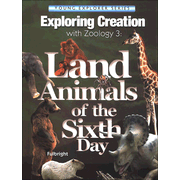
Land Animals of the Sixth Day:  Exploring Creation with Zoology 3   This book was the core textbook for the zoology class my son took at our co-op his 6th grade year.  They covered the book in a school year, covering 1 chapter every two weeks.  In my opinion, for a 6th grader, this book can be covered easily in one semester.


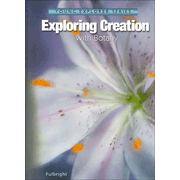
Exploring Creation with Botany  This semester, I started this book with both boys (3rd and 7th grades), and I purchased the notebooking journals that accompany the textbook.  I read a section aloud to the boys, and we work on the activities together.  Due to a busy spring, we are working slowly.  However, we built the suggested light hut and have lots of little plants growing inside waiting to be transplanted outside.  If I can ever remember to buy the appropriate flower, we will do the flower dissection!


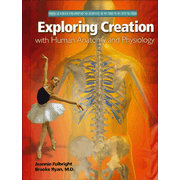
Exploring Creation with Human Anatomy and Physiology  
I hope to do this book next with both boys, right after finishing botany.  I purchased the Anatomy Notebooking Journal and the Junior Anatomy Notebooking Journal.  Had I known that the Junior version had coloring pages added in, I would not have purchased it.  If you child enjoys coloring (my third grader does not), then your child may like it.  


****NOTE:  For the month of March 2012, Apologia Elementary Science is 30% off at CBD.  This is a GREAT deal.  

Thursday, January 5, 2012

FREE Fun at The Lunar and Planetary Institute

The Lunar and Planetary Institute has free family friendly night sky viewing about 4 times a year.  Also, on that night, they have fun hands-on activities for children.  We've done these activities in the past, and they are very cool yet educational.  


For more information, see Lunar and Planetary Institute's website.  


Until this year, the institute had free Family Space Days on a monthly basis.  They are moving these fun days to local libraries, and the website says to check your local library to find a program nearest you.

In addition, at the website, on the left-hand side, you will see activities that were used in past Family Space Days.  For example, under moon, there are many activities and worksheets available to print and use at home.  One of our favorites was making the phases of the moon with Oreo cookies!  Yum!


Lunar and Planetary Institute
3600 Bay Area Boulevard
Houston, Texas 77058

Thursday, December 1, 2011

Learning through Lapbooks -- Scrapbooking Meets Education

     When my oldest was younger, I struggled with making certain subjects more hands-on and creative.  One day, a dear friend of mine pulled out her twins' lapbooks on the solar system.  After a quick scan through the pages of these fun, fold-out books, I knew I had found the answer that I was looking for.
     What is a lapbook?  A lapbook (or lap book)  is basically a cumulative project from a unit of study made out of a file folder, card stock, and imagination.  They include many different folds of paper and cut-outs fastened to the inside of the book.  When finished, the child has a record of work studied and an impressive, colorful, project to share with others.  Lap books are almost like scrapbooking with an educational bent.
     Our family has used lapbooks for science.  However, they can easily be used in all areas of study such as history, a book study (such as the Little House on the Prairie), or a country or state study.
     When complete, the student has a creative lapbook on a subject that he or she can be proud of.  I encourage my children to share them with as many people as possible -- friends, neighbors, relatives.  Each time they share their lapbook, they are reviewing the subject matter.  Like a photo album or scrapbook, children love to look back through their lapbooks, again reviewing the content. 

Websites and Books
     If you would like some guidance on how to begin lapbooking, the Big Book of Books and Activities by Dinah Zike is a good place to start.  Dinah Zike was a pioneer in this new concept of cumulative mini-"books" and foldables that later became known as the "lapbook."  She has since come out with a variety of lapbook courses.  We have used Great Science Adventures:  The World of Space by Dinah Zike and Susan Simpson in which she uses "3D graphic organizers" that she calls "books" -- half books, 3 tab books, pocket books, vocabulary books, layered look books, 4 door books, trifold books, accordian books, 10 top tab books, etc.  The Ultimate Lap Book Handbook by Cyndy Regeling and Tammy Duby is another source, although I have not used this one.  
     Fortunately, there are enough resources online that you do not have to buy anything to figure out how to incorporate lapbooking into a school project .

For lapbook templates try:  
homeschoolhelperonline.com or homeschoolshare.com
Other sites with ideas or free lapbooks:  
http://www.thehomeschoolmom.com/teacherslounge/lapbooks.php
http://dynamic2moms.webs.com/
Free animal studies lapbooks  (these are favorites -- we've done Backyard Birds, Antarctica, and Chipmunks)
homeschoolshare.com

Examples:

This is a lapbook that Darius did on the Deep Sea in 6th grade.  He chose the topic, and we used the free templates and ideas to make the "books" on the inside.  We used several library books and the internet for our research.


You use a file folder as your starting point.  I taped in two 8 1/2 x 11 pieces of cardstock on top and on the bottom (gray and orange.)  Then I added a green flip up piece on the right.  On each of these, front and back,  are vocabulary words, animals, information about underwater submarines used for exploration, etc.  Everything in the book opens or turns to reveal information (sort of like a pop-up book).  When you are finished, you fold everything back into the lapbook.

This is a lapbook that Titus did on Antarctica last year as a 2nd grader.  We used Mary Pope Osborne's Penguins and Antarctica (Magic Tree House Research Guide) as our main source of information.  Everything in this lapbook is from Homeschoolshare.com.  I printed out their free lapbook pages from their animal studies section which correlated with the Osborne book chapter by chapter.  We also checked out several books from the library about penguins.
 When you first open the lapbook, this is what you see.  Then the gray pages open up to reveal more information.


This picture shows how the mini-books on the inside of the lapbook open out to reveal information.

My oldest made this Earth Science lapbook in the 2nd grade.  He's in the 7th grade now, but he still likes to look through it.
This lapbook was our first one.  I made all the folds and little books myself using the patterns in Dinah Zike's Big Book of Books and Activities.


      After we finish with the lapbooks, we take them to the Houston Zoo's Naturally Wild Swap Shop to share them with the naturalists there (if they are nature related).  I also encourage the boys to share them with Daddy, grandparents, and others.  
     Lapbooking allows my kids to be creative, enjoy a cumulative final project, share what they have learned with others, and review subject matter again and again.  It's a great way to learn!

 
Thanks to Sherri A. for introducing me to the wonderful world of lapbooking.

Tuesday, November 1, 2011

The Houston Zoo's Naturally Wild Swap Shop

     The Houston Zoo's Naturally Wild Swap Shop is a hidden little gem in the Children's Zoo area of the Houston Zoo.  The Swap Shop is a place where children can bring items they have found on the ground, learn about them,  tell about them, and trade them in for other cool nature items such as rocks, fossils, seashells, etc.  Also, the naturalists will listen to your children present nature projects that they have done in school or your homeschool, ask them questions, and award them points to spend.  Besides the zoo membership or zoo entry fee, this program is free, and it is a wonderful way for your child to practice public speaking, to reinforce and review what he or she has learned, and to be rewarded.  You just can't lose.
     My youngest has taken in projects on chipmunks, backyard birds, the Antarctic, and strange sea creatures.  My oldest took in his Zoology notebook from the class he took at the REACH co-op, lapbooks on invertebrates and deep sea creatures, and reports he wrote on the chocolate chip sea star and the African wolf snail.  My boys have also taken in lichen on a stick (and received extra points for knowing that hummingbirds make their nests out of lichen), cicada shells, etc. (For a list of what you canNOT bring, see the website).
     As you enter the children's area of the zoo, the Swap Shop is located on your right, across from the splash area. The Swap Shop's hours are 9:00-11:45 and 1:00-3:45, and it is closed on major holidays.  It used to be closed on certain days of the week, but those days are no longer listed on the website.  If you want to call and check to be sure it is open, the zoo's number is 713-533-6500.
     You are allowed to present 3 projects or objects during a visit.  Some naturalists praise the children until they are glowing and give out points generously, and others are more conservative.  However, I cannot complain.  My children love to present, they love the prizes, and I love the educational benefits.  Besides, it gives you a place to get rid of all that yucky stuff  take those precious collections of snake skins, cicada shells, dead insects, rocks, pine cones, sea shells, and leaves -- and they get rewarded for it!
    
Thanks to my wonderful friend, Marla F., for introducing us to the Houston Zoo's Naturally Wild Swap Shop.

From the website:

How It Works:

  1. Find a natural item you are interested in or would like to know more about.
  2. Learn all you can about your item.
  3. Bring your item to the Swap Shop and discuss what you learned with our Naturalist.
  4. Earn points for your item and for your knowledge about the item.
  5. Trade your points for something in our collection or save them for later.

You Can Earn Points For:

  1. Knowledge - What do you know about your item? Have you learned something interesting about your item?
  2. Quality -  Is your item clean? Is it in good condition?
  3. Effort  - What did you do to find your item? How much time did you spend researching and learning about it?