Showing posts with label Books. Show all posts

Monday, September 24, 2012

The Birds, the Bees, and Boys: Teaching Your Boys About Sex -- Part 3, a Book Review

     In  The Birds, the Bees, and Boys: Teaching Your Boys About Sex Part 1, I discussed how to form and model a healthy, Biblical view of sexuality, tips on talking about sex, and other topics leading up to puberty.  Then, in The Birds, the Bees, and Boys: Teaching Your Boys About Sex Part 2, I explained the "nitty-gritty" of puberty:  physical and emotional changes, the importance of fathers, and the continual need for a mother's love.  Finally, I want to share a book that may help you as you introduce your son to how he is changing.
     When our oldest was still pretty young, my husband and I decided we needed a good book to introduce our son to puberty and sex.  I asked other mothers of boys, did internet searches, and bought a few, but I didn't find one that my husband and I liked.  Then, by God's providence, I came across this one, and we have been very pleased with it.


How You Are Changing:  For Boys Ages 10-12
Book 3 of the Learning about Sex Series for Boys
from text originally written by Jane Graver, 
updated and revised

     This book is a gentle introduction to puberty that goes into, in my opinion, just the right amount of detail.  The book is filled with Scripture, has a prayer at the end of each chapter, and encourages young men to embrace themselves as creations of God.  Other books show pictures that would make most boys uncomfortable.  For example, in Before I Was Born (for ages 5 to 8) by Carolyn Nystrom, published by NavPress, there is a somewhat realistic drawing of a mother giving birth.  I realize that some families choose to have older children present during childbirth, but for young boys who have not had this experience, this picture (see below) and others like it could make them feel uncomfortable.  
From God's Design for Sex Series, Before I Was Born,  Book 2, Ages 5 -8, by Carolyn Nystrom, NavPres.
This drawing and others like it would make a young boy going through puberty uncomfortable.  
Notice that the recommended age range for this book is 5-8.  


In contrast, How You Are Changing uses more ink-type drawings that do not have a realistic feel but are instructive.  
From Learning About Sex for the Christian family, How You Are Changing, Book 3, For Boys ages 10-12, Concordia Publishing House. The entire subject will make boys uncomfortable, but the pictures in this book offer enough information to be instructive without the realism that impedes the point.

    How You Are Changing is only 56 pages long and contains 8 chapters.  My husband asked my son to read about a chapter a week when he was 12 years old.  Then they would discuss the chapter together at McDonald's or at home when little brother was in bed.  The age range for this book is 10-12; however, I don't think he would've been ready at age 10.  Age 11 and a half probably would have been fine.  However, your son may be different.  If he is in public school and has heard some things in the locker room or has friends who have shared with him some juicy tidbits, then it may be time to go ahead and read the book together.
     The tone of the book is light yet serious.  After reading it, your son should come away feeling like he knows what to expect and that it's new and different but part of God's plan.  This series also has a set of books just for girls.
     Below is a brief summary of each chapter.  

Chapter 1.  You Are Wonderful
This chapter is about how God created your son to be male.  It goes on to discuss how girls and boys are different physically -- but also in other ways, such as emotionally.  It emphasizes that no sex, male or female, is better than another.  It encourages your son to remember:  You are special, you have talents, and God loves you very much.

Chapter 2.  Male + Female + God's Gift of Life = BABY
Using appropriate pictures, this chapter show how the bodies and reproductive organs of men and women are physically different. Then, the chapter discusses how a brand new person is made:  "When a sperm cell from your father met and united with an egg cell in one of your mother's fallopian tubes, your life began.  In that instant, the question of whether you were going to be a boy or a girl was decided.  ....The egg cell and the sperm cell did more than just stick together.  Following God's design, the two cells changed into one new cell -- the beginning of a brand-new person!  That tiny life has all the DNA factors that make a person unique -- that make you you." (p. 18)
     Later the chapter discusses family as a gift from God and the subject of difficult families, followed by God's plan for families.  The book describes intercourse on page 22:  "At times, a husband and wife will want to express their love for each other in a special way called sexual intercourse.  At those times, they will go off by themselves.  They will hug and kiss each other and touch each other all over.  The husband's penis will become firm and hard, able to fit inside his wife's vagina.  This is a private act between husband and wife."  Finally, the book discusses how it is God's plan for only a husband and a wife to "make love in this way" (p. 23)

Chapter 3.  God Took Care of You ... Right from the Beginning
This chapter explains how a baby starts out smaller than a dot and then miraculously becomes a baby.  Later, the chapter addresses where babies come out  "...the vagina and vulva stretched to let you come out between your mother's legs."  (p. 28)  

Chapter 4.  You've Grown!
Chapter 4 uses a dialogue format and answers questions and concerns such as:  "Some kids think sex is dirty":  "As we said, some people have mixed-up and sinful ideas about sex.  They might be embarrassed by using the right words for penis and vagina, for instance, so they use slang words instead.  Or they get their information from jokes and made-up stories instead of from an adult they can trust, like a parent.  We are reminded in Matthew 15:19 (ESV) that 'out of the heart come evil thoughts...sexual immorality'"  (p. 36).  Other concerns are discussed such as being embarrassed to talk with parents about sex and wanting to be alone. 

Chapter 5.  Next Step:  Adolescence
This section discusses "How Boys Change" -- weight, height, hair, testicle growth, erections, voice changes, wet dreams, etc. in under 2 pages, then moves on to "How Girls Change," about a page in length and covers period, menstruation, breasts, etc.

Chapter 6.  Am I Normal?
This chapter addresses boys of different shapes and sizes, circumcision, different rates of growth, and weight gain.

Chapter 7.  Feeling Good about Your Sexuality
Written as a dialogue between a teen boy and the author, this chapter broaches such subjects as inappropriate tv shows, watching girls, sexual abuse, smoking, drugs, and alcohol.

Chapter 8.  It's Great to Be Alive!
This final chapter is an encouragement to young, growing boys that it is special to be human and that God has a special love for his human creations.  Furthermore, the author describes "God's good gift of sex" as a means to bring other wonderful children into the world.  "God's love can make sex a wonderful part of your love for another person.  Guided by Him, you can choose a wife who will share your life.  The love you have for each other will be extra-special if God lives in both of you."  (p. 55)

     Overall, this book is an encouraging, unabashedly Christian discussion of male sexuality written in a light, easy-going manner.  I highly recommend it.

Wednesday, August 15, 2012

Who's the Hero? Thoughts on the Hunger Games Series

*****SPOILER ALERT*****SPOILER ALERT*****SPOILER ALERT*****SPOILER ALERT*****  
Do not continue reading 
if you plan to read the Hunger Game books or if you have not finished the books!


     I just finished the Hunger Games series last night.  I closed the final book and tried to name the emotion I felt.  Satisfied.  I was satisfied.  
     Suzanne Collins is an incredible writer who created a page-turner with surprises so shocking that I actually gasped out loud once or twice.  However, she is not writing from a Christian point-of-view and that makes working out the tension between good and evil (sin) difficult.  She writes of a society gone terribly wrong with no Redeemer in sight.  That makes swallowing the story line and facing the incredible evil a problem, and although Katniss sparks the revolution, she is NOT the hero.
     Although Katniss is willing to die for her sister, her positive qualities are limited.  She feels compassion towards the Avox she did not save, and Rue, the little girl who reminded her of her sister.  Although she is smart, intuitive, resourceful, brave, and fierce, she is also quick to anger, selfish, distrustful, and suspicious, and she knows it. The girl on fire, fueled by hatred and revenge, becomes a murderer, a survivalist, a manipulator, yet her behavior is completely understandable considering she almost starved to death when 11, watched her mother descend into deep depression, broke the law daily to save her family, and acted as an adult simply to survive the cruel society into which she was born.  The girl's got baggage, but it's important to remember, she is a girl, and she is a survivor.
     Gale is no better.  He starts out angry and then becomes vengeful, creating traps that play on human sympathies in order to kill others.  Even Katniss is uncomfortable with his methods.
     Peeta, on the other hand, is the only one in the series who seems to have a grasp of what the society has done and is capable of doing to ruin all that is good about humanity.  In book one he says, "'I don't want them to change me in there.  Turn me into some kind of monster that I'm not.'"  Despite President Snow's "hijacking," it is Peeta who is able to NOT become that monster.  When even Katniss stoops so low as to  call for a Hunger Games for the children of the Capital, Peeta, arguing with Haymitch, is appalled at "the atrocity he could become party to."  (Book 3).  While Gale is the one who brings Katniss the arrow to assassinate Snow, Peeta is the one who takes the nightlock from her.  
     Peeta.  I closed the book, and I was satisfied because of Peeta.  In the end, he redeems her.  He loves her unquestionably, faithfully, and unconditionally.  He never gives up on her.  He cares for her and those around him.  He does what is right, what is good.  He sees beauty in the darkness.  He never kills anyone in the book unless by accident, even when brainwashed.  Peeta.  It sounds like Peter, to me, and if so, it means "rock."  Peeta is a rock -- unchanging, steadfast.  Peeta is hope.  Peeta does not become the monster, never crosses that line, redeems Katniss with his love, and in the end, redeems the humanity that has become reduced to a Darwinian world of the strongest and most deadly survive.  Peeta makes Katniss and the world around him a better place, and that is why I am satisfied.


     For a different opinion, see Why the Hunger Games is Flawed to Its Core.  I respect N.D. Wilson very much, and I've read all his books.  However, I don't agree that Peeta is a wimpy, passive guy.  He's a teenager trapped in a hopeless system.  Yes, I would have loved it if, in the first book, Katniss cut out her arm tracker and saved the other tributes from the bad tributes, but then what?  The Gamemakers could have killed her off quickly, and then the books would be over.  Finally, I disagree that revolutions aren't started by small things like berries.  In that moment, she decided it was better to kill herself and Peeta than to let them win, to force her to do the unthinkable -- kill her friend.  That was a huge act of courage that could indeed spark a revolution if such a terrible world existed and that entire world was watching live, but that is just my opinion.  

NOTE:  Considering the darkness of the books, I think parents need to be very wary of allowing children younger than 13 to read them.  By the third book, the author is describing the tributes being used as sex slaves, and we must remember -- the tributes are children.  Alcohol and drug abuse, brutality, murder, evil -- all of this is dark and takes maturity to work through.


Monday, March 5, 2012

Apologia Elementary/Middle School Science -- Strong Science for Ages 6-12

     Both of my boys love science.  When young, we would check out lots of books from our local library on a wide range of science topics.  However, we found that many science textbooks for the elementary and early middle school ages are weak and boring.  Fortunately, Apologia, well-known in the high school science market, now offers a science curriculum for elementary and middles schoolers that boasts strong science with a viewpoint that points to the Creator.  
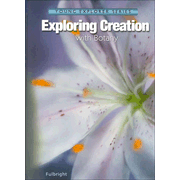
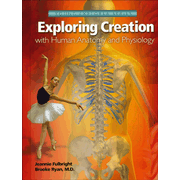
     Jeannie K. Fulbright has authored six excellent books which delve into zoology, botany, astronomy, and human anatomy.  Each book contains 13 or 14 chapters and can be used for ages 6-12, with modifications, of course.  Notebooking journals are available for purchase, or you can print out pages from each course's free website.  The textbooks are full of beautiful and interesting illustrations, activities, hands-on assignments, experiments, projects, and more.  I highly recommend them because they are strong scientifically and yet Christian in viewpoint.
     Below is a list of the Apologia books and how we have or will use them.


Exploring Creation with Astronomy -- When my oldest studied astronomy in 2nd or 3rd grade, I read this to him, and he created a lapbook.  We used The Usborne First Encyclopedia of Space and The World of Space by Dinah Zike and Susan Simpson in conjunction with this book.


Flying creatures of the Fifth Day:  Exploring Creation with Zoology 1    After completing the Zoology 3 book in our co-op, my son read this book and the Zoology 2 book on his own at home in his 7th grade year.  He finished both books in about two and a half months.  We did not do the activities, and I did not test him.  He read for pure love of science.


Swimming Creatures of the Fifth Day:  Exploring Creation with Zoology 2  See above.


Land Animals of the Sixth Day:  Exploring Creation with Zoology 3   This book was the core textbook for the zoology class my son took at our co-op his 6th grade year.  They covered the book in a school year, covering 1 chapter every two weeks.  In my opinion, for a 6th grader, this book can be covered easily in one semester.


Exploring Creation with Botany  This semester, I started this book with both boys (3rd and 7th grades), and I purchased the notebooking journals that accompany the textbook.  I read a section aloud to the boys, and we work on the activities together.  Due to a busy spring, we are working slowly.  However, we built the suggested light hut and have lots of little plants growing inside waiting to be transplanted outside.  If I can ever remember to buy the appropriate flower, we will do the flower dissection!


Exploring Creation with Human Anatomy and Physiology  
I hope to do this book next with both boys, right after finishing botany.  I purchased the Anatomy Notebooking Journal and the Junior Anatomy Notebooking Journal.  Had I known that the Junior version had coloring pages added in, I would not have purchased it.  If you child enjoys coloring (my third grader does not), then your child may like it.  


****NOTE:  For the month of March 2012, Apologia Elementary Science is 30% off at CBD.  This is a GREAT deal.  

Thursday, February 9, 2012

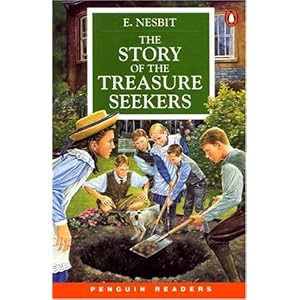
The Story of the Treasure Seekers by E. Nesbit -- A Great Read Aloud!

     "This is the story of the different ways we looked for treasure, and I think when you have read it you will see that we were not lazy about the looking."   From the first sentence of the first page, The Story of the Treasure Seekers:  Being the adventures of the Bastable children in search of a fortune, by E. Nesbit gets right to the point, and the adventures that follow are as irresistible as the Bastable children themselves.
     Originally published as short stories in magazines and put into book form in 1899, The Story of the Treasure Seekers is the delightful tale of the six Bastable children, Dora, Oswald, Dicky, Alice, Noel, and Horace Octavius (H.O.)  After their mother dies ("and if you think we don't care because I don't tell you much about her you only show that you do not understand people at all") and their father also falls ill, "his business-partner went to Spain -- and there was never much money afterwards."  As creditors start calling and the children must leave school because father can no longer afford it, they decide they must do something to restore their fallen fortunes.  Each child comes up with a plan, and, well, their plans are hysterical.  Oswald suggests stopping "people on Blackheath -- with crepe masks and horse-pistols -- and say 'Your money or your life!  Resistance is useless, we are armed to the teeth.'"  Other ideas include rescuing an old gentleman in deadly peril, using a divining-rod to search for gold, becoming bandits, finding a princess and marrying her, becoming detectives, and digging for treasure.  Fortunately for us but not so much for their father, they actually carry out their plans and much hilarity ensues.
     Written over 100 years ago, this book has never lost its appeal to readers young and old alike.  My boys were ages 11 and 8 when I read it, and we all laughed from beginning to end.  I recommend it as a read aloud because it's great fun for the entire family and because there are some vocabulary words that are difficult.  It was written in the 1890s, afterall.
     I leave you with a poem, written by Noel.  If you have a child who is sad, here in Houston, when the dead June bugs litter the sidewalks, then you'll love this poem.
     
Lines on a Dead Black Beetle that was poisoned
Beetle how I weep to see
   Thee lying on thy poor back!
It is so very sad indeed.
   You were so shiny and black.
I wish you were alive again
But Eliza says wishing it is nonsense and a shame.


     "It was a very good beetle poison, and there were hundreds of them lying dead -- but Noel only wrote a piece of poetry for one of them ...and the worst of it was he didn't know which one he'd written it to -- so Alice couldn't bury the beetle and put the lines on its grave, though she wanted to very much."     (Chapter 4)


Thanks so much, Holly S., for recommending this book!  We LOVED it!

Tuesday, February 7, 2012

100 Cupboards Trilogy by N.D. Wilson -- EXCELLENT!

     After reading N.D. Wilson's first book, Leepike Ridge, my oldest son and I sped through his three novels in the 100 Cupboards Trilogy:  The 100 Cupboards, Dandelion Fire, and The Chestnut King.  I started reading first, but by the third book, my son passed me and eagerly waited for me to finish so we could talk about the ending.  Each book grew longer (320, 480, 512 pages), but neither of us wanted to put them down.  When he finished reading at night, I asked him to leave it on the floor by his bed so I could snag it.  They were just that good.
     After his parents are kidnapped, Henry York, age 12, ends up in a town called Henry, Kansas, living with his Uncle Frank and Aunt Dotty and their three children, Penelope, Anastasia, and Henrietta, whom they also called Henry until Henry moved in with them.  One night, he finds plaster in his hair and using the knife Uncle Frank had bought for him, picks all the plaster off the wall to find 100 cupboards of all shapes and sizes, and thus begins his adventures.
     So Henry, a young, unlikely hero, who throws up when scared and whose parents made him wear a helmet to P.E. class, never told him he was adopted, and continually left him with nannies and in boarding school, finds 100 new worlds and a surprising heritage, learns to be brave, discovers baseball, family, and friendship, and, by the end, is given an impossible, Frodo-like, task.  It's a classic tale of good vs. evil, with well-developed, unique, irresistible characters and some pretty rotten, evil ones, too.  The plot keeps you guessing, and the writing is pleasantly refreshing, unique, and unexpected.   You'll find yourself holding your breath, cheering for Henry and his family, and hoping he doesn't lose everything he has just gained.  There are funny parts, intense battle scenes and fights, and loving and tender moments.  Unlike some book series which end badly as if the author didn't know how to wrap it up, this book ties up beautifully at the end, leaving you satisfied.  
     My favorite part, though, is that the boys are young, but they are loyal, keep their word, face fear, and grow as young men.  Henrietta starts out as an impulsive, sneaky girl, stubborn, and obsessively curious and turns into a brave, still-stubborn, yet strong young woman by the end.
     As a fantasy series, this is one of my favorites; it may not be The Lord of the Rings or The Chronicles of Narnia, but it is very close.  Wilson's first novel, Leepike Ridge is good, but his 100 Cupboards Trilogy is incredible.  His next series, Ashtown Burials, is out, and we can't wait to read the first book!


     N.D. Wilson wrote an article for DesiringGod.com called "Stories Are Soul Food: Don't Let Your Children Hunger" on why our children need good strong stories of good and evil, and even magic.  I wrote earlier about Wilson's father, Doug Wilson, author of Future Men, here.  (It was quite by accident and a cool coincidence that I found out that N.D. Wilson and Doug Wilson were thus related!)   For a three-chapter-sample of 100 Cupboards, click here.
     Finally, I leave you with two quotes from the last book, The Chestnut King; quotes which reveal why both my son and I loved this series.

     "Frank opened his mouth.  He wanted to make her promises, to tell her lies, but he couldn't.  Instead, he leaned his face over into her wet, straggling hair.  
     "'Dots,' he whispered.  'You're my life, and I've loved it.'  He drew in her smell, and she leaned her head against his lips.  'Every kiss, every dirty look, every night we slept between clean, starchy sheets, and every night we didn't.  Every nag and needle and nudge.'
     "He sat up.  'Your peaches,' he said.  'And your applesauce.  How many pies do you think I've eaten in my life?'  He looked down at her.  'Not enough.'  He smiled.  'If we get out of this, there needs to be more pie.  That's all the complaining I've got.'"  -- Frank to Dotty when it seems they will both die soon, The Chestnut King


     "Let evil hear the pounding of our feet!  Let evil hear our drumming and our chanting songs of war.  Let evil fear us!  Let evil flee!  In any world, may dark things know our names and fear.  May their vile skins creep and shiver at every mention of the faeren.  Let the night flee before the dawn and the darkness crowd into the shadows.  We march to war!"  -- King Nudd, The Chestnut King


Note for parents:  I recommend this series for children ages 10 and up, maybe older, depending on the sensitivity of your child.  My son is 12.  The books contain fighting and other violence, bloodshed, death, some very dark moments, and magic.  The 2nd book uses the profanity d**n. 

Thursday, January 19, 2012

Mrs. Piggle-Wiggle -- A Great Read Aloud

     When I first began reading Mrs. Piggle Wiggle by Betty MacDonald aloud to my two boys, I wasn't sure what to expect.  We quickly found ourselves chuckling, giggling, and laughing out loud.
     Mrs. Piggle-Wiggle is an older lady who lives in an upside down house with "no family at all."  However, she quickly befriends all the neighborhood children with her stories, games, and fun!  She allows the kids to dig for treasure in her backyard, comb her hair, and make a mess baking cookies in her kitchen.  The real laughs begin, though, when Mrs. Piggle-Wiggle begins to give the neighborhood parents "wonderful cures" to help them correct their children's poor behavior.  Her cures include The Won't-Pick-Up-Toys Cure, The Answer-Backer Cure, The Never-Want-To-Go-To-Bedders Cure, The Fighter-Quarrelers Cure, and more.  All of these cures are hilarious, but when we got to The Radish Cure to help little Patsy learn to take a bath, I laughed so hard I cried!
     Mrs. Piggle-Wiggle is eight short but wildly-entertaining chapters long and highly recommended by the Mullin family!  


Note:  If you don't read aloud books as a family, turn off the television and try reading this book together.  It's great, cheap, memorable family fun!  

Tuesday, January 3, 2012

BOOKS! Part 2 -- A Reading List for 4th grade and Older

      As promised, here is a book list for 4th grade through middle school.  As we find good books, I will update the list so check back every once in a while! 

  • Author - Chris Van Allsburg RL 3.7-4.9 The Polar Express, Jumanji, Zathura: A Space Adventure, etc.  (His beautifully illustrated picture books tend to get made into movies!)
  • Wayside School books by Louis Sachar RL 3.3-4.3  Sideways Stories from Wayside School, Wayside School Is Falling Down, Wayside School Gets a Little Stranger, Sideways Arithmetic from Wayside School  I have never read these.  However, both of my boys have read them multiple times.  I believe the way I would describe them is ridiculously funny.  My youngest, age 12, just reread them all again.  
  • Encyclopedia Brown by Donald J. Sobol RL 4
  • Dragonbreath Series by Ursula Vernon RL 3.7-4.3, short reads, lots of pictures Dragonbreath, Dragonbreath: Attack of the Ninja Frogs, Dragonbreath: Curse of the Were-Weiner ,  Dragonbreath: Lair of the Bat Monster, Dragonbreath: No Such Thing as Ghosts , Dragonbreath: Revenge of the Horned Bunnies, Dragonbreath: When Fairies Go Bad, Dragonbreath: Nightmare of the Iguana, Dragonbreath: The Case of the Toxic Mutants, Dragonbreath: Knight-napped! 
  • Hank the Cowdog Series  by John R. Erickson RL 3.5-5.4, almost 60 titles, Listen to some of his books on CD first and get the voices in your head -- Erickson, a former cowboy and ranch manager, and his west Texas drawl are hilarious!
  • 39 Clues by various authors, RL3.0-5.0  (mystery/adventure stories, first is written by Rick Riordan, author of the Percy Jackson series.  My son says that the 2nd series of these books are too violent and not very good.  He did, however, like the first series.)
  • McGrowl series by Bob Balaban RL 4.0
  • Origami Yoda Series by Tom Angleberger RL 4.0 to 5.0  The Strange Case of Origami Yoda, Darth Paper Strikes Back, The Secret of the Fortune Wookiee, Art2-D2's Guide to Folding and Doodling, The Surprise Attack of Jabba the Puppett, Princess Labelmaker to the Rescue!, Emperor Pickletine Rides the Bus  (My 6th grader is reading these -- and so is his 10th grade brother!)
  • Author Beverly Cleary RL 3.5-5.6   Henry Huggins (1950), Henry and Beezus (1952), Henry and Ribsy (1954), Beezus and Ramona (1955), Henry and the Paper Route (1957), Henry and the Clubhouse (1962), Ribsy (1964), Ramona the Pest (1968), Ramona the Brave (1975), Ramona and Her Father (1977), Ramona and Her Mother (1979), Ramona Quimby age 8 (1981), Ramona Forever (1984), Ramona's World (1999), The Mouse and the Motorcycle, Runaway Ralph, Ralph S. Mouse   (Some of her books are for older children:  Dear Mr. Henshaw (deals with divorce), Jean and Johnny, etc.)
  • Author E.B. White – Stuart Little 3.9, Charlotte’s Web 4.9, The Trumpet of the Swan 5.1
  • Little House on the Prairie series by Laura Ingalls Wilder RL 4-5
  • Illustrated Classics – Adaptations of classical works, a great way to introduce your child to the classics – RL 4.0 and up
  • Holes by Louis Sachar RL 4.6, recommended for ages 5th grade and up
  • The Tale of Despereaux by Kate DiCamillo RL 4.8, not a series
  • Bloodhounds Inc. series by Bill Myers for ages 8-13, Christian author, hilarious
  • TJ and the Time Stumblers series by Bill Myers for ages 8 and up, Christian author
  • The Cooper Kids Adventure Series by Frank E. Peretti, Christian author, RL 5-6
  • The Spiderwick Chronicles by Tony DiTerlizzi and Holly Black, RL 4.0
  • Beyond the Spiderwick Chronicles by Tony DiTerlizzi and Holly Black (RL 4.0)
  • The Invention of Hugo Cabret by Brian Selznick, RL 5.1  (Half novel, half illustrations, mysterious with a happy ending.  A dead body is mentioned.  Movie Hugo based on this book.)
  • A Wrinkle in Time by Madelein L’Engle RL 5.8 (Also, A Wind in the Door, A Swiftly Tilting Planet, and Many Waters (My oldest said to skip Many Waters – it was not as good as the others).
  • The Chronicles of Prydain  by Lloyd Alexander RL 5.5, The Book of Three, The Black Cauldron (Newbery Honor), The Castle of Llyr, Taran Wanderer, The High King (Newbery Medal), The Foundling and Other Tales from Prydain
  • Cricket in Times Square by George Selden RL 5.9, not a series
  • Hardy Boys by Franklin W. Dixon RL 5-6
  • The Toothpaste Millionaire by Jean Merrill RL 5.9, not a series (both of my boys loved this book)
  • Mrs. Frisby and the Rats of NIMH by Robert O’Brien RL 5.8, not a series
  • Chronicles of Narnia by C.S. Lewis RL 5.5-6.1
  • Indian in the Cupboard by Lynn Reid Banks RL 6, Also, The Return of the Indian, The Secret of the Indian, The Mystery of the Cupboard, The Key to the Indian  (a few "bad words" in this series)
  • Where the Red Fern Grows by Wilson Rawls RL 6.4, not a series, one of our favorites
  • My Side of the Mountain by Jean Craighead George RL 6.7, Also, On the Far Side of the Mountain, Frightful’s Mountain, Frightful’s Daughter, Frightful’s Daughter Meets the Baron Weasel  (We have not read the last 2 of these.)
  • Charlie and the Chocolate Factory by Roald Dahl RL 5.9, not a series
  • The Westing Game by Ellen Raskin RL 6.1, The only mystery to win a Newbery, not a series
  • The Berinfell Prophecies by Wayne Thomas Batson and Christopher Hopper, Christian authors, The Curse of the Spider King, Venom and Song
  • The DragonKeeper Chronicles:  DragonSpell, DragonKnight, DragonQuest, DragonFire, DragonLight by Donita K. Paul, Christian author  (Grades 4 and up)
  • Wingfeather Saga by Andrew Peterson, Christian author and singer/songwriter, On the Edge of the Dark Sea of Darkness, North or Be Eaten, The Monster in the Hollows, The Warden and the Wolf King   “The evil was a nameless evil, an evil whose name was Gnag the Nameless.” – from the introduction, GREAT, quirky, fun, adventure books!  
  • Island Series by Gordon Korman, Shipwreck, Survival, Escape  (a story of kids stranded at sea and then on an island -- death in the stories) (RL 4.0)
  • Redwall Series by Brian Jacques (RL 6-8)  23 books so far in this series, for ages 6th grade and up
  • Hatchet by Gary Paulsen, RL 6.3  This book is one of the most recommended by librarians, etc.  However, know your child because there are some more mature themes.  SPOILER ALERT:  At the beginning of the book, the pilot dies of a heart attack which strands the hero, a thirteen-year-old boy, in the wilderness.  Also, he recalls throughout the book seeing his mother with another man while married to his dad and struggles with whether or not to tell his father post-divorce. This book is mostly a great story of survival, but I waited until my son was older because of the above themes.
  • Lawn Boy by Gary Paulsen, RL 4.3.  This book is hilarious and seems like it should be written by Louis Sachar, not Gary Paulsen!  It's a short read, and I would require it to be read by anyone studying economics!
  • The Adventures of Tintin Series by Herge' (RL is 3rd grade.  However, books include lots of whiskey drinking!  Comic books written from 1929 to 1976).
  • Percy Jackson and the Olympians by Rick Riordan RL 3-4  (Reading level is easier, but content is more middle school.  Contains heavy god/goddess worship, misdeeds, etc.  Towards the end of the series, Percy is older, and the book crosses into boy/girl relationship saga but not too heavily.  My oldest read the entire series in 7th grade in little over a week.  However, Greek myths were never a threat to his faith while I still haven’t studied such myths with my youngest.) 
  • The Heroes of Olympus series by Rick Riordan  (These books introduce new characters and brings back Percy and many of his friends.  However, the kids are not 16 and 17 years old, and there is kissing and 'I-love-yous', and other teenage romance drama.  In addition, you find out that a character is gay -- and that he had a crush on Percy Jackson.)
  • Seven Wonders series by Peter Lerangis -- The Colossus Rises, Lost in Babylon, The Tomb of Shadows, The Curse of the King, The Legend of the Rift  for ages 6th grade and up.  Teens caught up in modern adventure and ancient series -- reminds me a bit of the Percy Jackson series.
  • The Chaos Code by Justin Richards (Mystery, adventure, action story.  Note:  parents divorced, uses the *b---h* word once)
  • The Adventures of Tom Sawyer and Adventures of Huckleberry Finn by Mark Twain   RL 5.9 (Tom Sawyer is a wonderful read aloud.  Both books contain plenty of uses of the word n*****r -- especially Huck Finn.  However, it is clear that Mark Twain, unlike Harriet Beecher Stowe, is using humor and inference to show that he believes slavery to be wrong.  I personally would recommend reading Huck Finn in high school.  Also, if not done as a read aloud, discuss with your student that the n-word should never be used!)
  • Margaret Peterson Haddix, The Missing Series:  Found, Sent,. Sabotaged, Torn, Caught, Risked, Revealed, Redeemed (mystery, history, and time travel)
  • Anything written by N.D. Wilson,   100 Cupboards Trilogy: 100 Cupboards 3.7, Dandelion Fire 3.7,  The Chestnut King 3.5, Leepike Ridge 3.7, Ashtown Burial Series:  The Dragon's Tooth (The 100 Cupboards Trilogy is great!  However, the content is older.  In Leepike Ridge, the boy's father is murdered, and he encounters a dead body.)  Boys of Blur is his newest stand-alone book (lead character's father is abusive, but not descriptive) -- a great read.
  • N.D. Wilson, Ashtown Burials series:  The Dragon's Tooth, The Drowned Vault, Empire of Bones  (can't wait until the next one comes out!)
  • N.D. Wilson, The Door Before -- This book is a prequel to both the 100 Cupboards and ties in Ashtown Burials.  It's amazing!  I read it in 2 days!
  • N.D. Wilson, Outlaws of Time series: The Legend of Sam Miracle, The Song of Glory and Ghost, and The Last of the Lost Boys
  • John Flanagan, Ranger's Apprentice series, 12 books,  all awesome!  The Ruins of Gorlan 6.6, The Burning Bridge, The Icebound Land, The Battle for Skandia, The Sorcerer of the North, The Siege of Macindaw, Erak's Ransom, Teh Kings of Clonmel, Halt's Peril, The Emperor of Nihon-Ja, The Lost Stories, The Royal Ranger  Prequels: The Tournament at Gorlan and The Battle of Hackman Heath 
  • John Flanagan, Brotherband series:  (spin-off from the Ranger's Apprentice series, different country, some of the same characters)  The Outcasts 4.7, The Invaders, The Hunters, Slaves of Socorro (in this one, the Herons work with a famous Ranger from his first series), Scorpian Mountain, The Ghostfaces, The Caldera 
  • John Flanagan, Ranger's Apprentice: The Royal Ranger series:  A New Beginning,The Red Fox Clan 
  • The Ascendance Trilogy by Jennifer A. Nielsen  If you like the Ranger's Apprentice series, you'll like this one, too!  Mystery, suspense, adventure, etc. The False Prince, The Runaway King, and The Shadow Throne   RL 4.4-5.0  The False Prince is one of my all-time favorite books.
  • Richard Paul Evans, Michael Vey series:  The Prisoner of Cell 25, The Rise of the Elgen, Battle of the Ampere, Hunt for Jade Dragon, Storm of Lightning, Fall of Hades, The Final Spark  (This is one of the best series I've read in a long time.  My youngest son read the entire series back to back in about 2 weeks at age 15.  He loved it, too.  It's right up there with Harry Potter for me.  Amazing friendships, a terrible, evil villain, brave kids with super powers, sci-fi/fantasy, and more!  Note: In one of the books, someone dies, and it is very sad.  Also, the villain is pure evil -- he may be disturbing for younger or sensitive children.)
  • Lord of the Rings Trilogy by J.R.R. Tolkien RL 8- and The Hobbit
****NOTE:  Rick Riordan's new series Magnus Chase and the Gods of Asgard has a "transfluid" character.  In his new series The Trials of Apollo, Apollo gives long monologues discussing why he doesn't care if his kids are gay.  I do not recommend these series.**********

Friday, December 30, 2011

Disciplining Future Men

     When I began this blog, I really wanted to avoid "deep thoughts" and simply use it as a way to share information.  So many others do deep thinking so much better than me, and I planned to leave all that to those who do it best.  However, lately, I've been mullin' over (couldn't resist) something that my dear husband read to me and that I later reread for myself.  First, some background. 

     Recently, at church, a dear friend of mine was introducing me to a friend of hers.  At that moment, this visitor's son ran up in tears, and I quickly discovered that my son was the cause.  Yep, my son decked the visitor's kid.  Why?  My son saw this strange boy chasing and "threatening" his friend, who was screaming, and without a lot of thought, ran up, and "rescued" his friend.  In reality, these two boys know each other and were goofing around.  I'd say that my son grossly misread the situation.  So what do you do?

     I was mortified.  I won't lie.  However, my approach to disciplining my son and thinking about this situation was very different due to something, as I said before, that my husband read to me from the book Future Men only a few days before this incident.  Pardon me for the length of this quote, but it's too good to paraphrase. (Highlighting is mine)

     Countless examples may be multiplied from any given day in the life of a small boy.  Say a boy breaks a chair because he was jumping on it from the bunk bed.  Unbelief sees the cost of replacing the chair.  Faith sees aggressiveness and courage, both of which obviously need to be directed and disciplined.  Suppose a boy gets into a fight protecting his sister.  Unbelief sees the lack of wisdom that created a situation that could have been easily avoided; faith sees an immature masculinity that is starting to assume the burden of manhood.
     Unbelief squashes; faith teaches.  Faith takes a boy aside, and tells him that this part of what he did was good, while that other part of what he did got in the way. "And this is how to do it better next time."
     This issue of fighting provides a good example of how necessary such distinctions are.  Of course parents do not want to encourage fighting in their sons.  But this is not the only item on the menu.  Neither do they want to encourage abdication and cowardice.  There are times when men have to fight.  It follows that there will be times when boys have to learn how to fight, how to walk away, how to turn the other cheek, when to turn the other cheek, and when to put up their dukes.  If boys don't learn, men won't know.  And boys will not learn unless their fathers teach.
     When Theodore Roosevelt was at Harvard, he taught Sunday school for a time at Christ Church, until he was dismissed. A boy showed up one Sunday with a black eye.  He admitted he had been fighting, and on a Sunday too.  He told the future president that a bigger boy had been pinching his sister, and so he fought him.  TR told him that he had done perfectly right and gave him a dollar.  The vestrymen thought this was a bit much, and so they let their exuberant Sunday school teacher go.
     Unbelief cannot look past the surface.  If there was any sin involved, unbelief sees only the sin.  Faith sees what was turned aside to the service of sin and seeks to turn it back again.  Sin is parasitic and cannot function without some good attributes that it seeks to corrupt.  Consequently, faith must distinguish that which must be preserved and developed and that which must be abandoned as sin.
     In addition, faith also sees the godliness in what many pietists, on their own authority, have come to call sin.  At the beginning of his life, a boy does not know what century he was born in, and consequently exhibits to many of his politically correct and aghast elders some of the same traits exhibited by the boyhood chums of Sennacherib and Charlemagne.  He doesn't know any better -- yet.  But in our day, many of these designed masculine traits are drilled or drugged out of him by the time he is ten.  Faith resists this ungodly process and defines sin by the Scriptures and not by pietistic traditions.
     So faith is central in bringing up boys, but it is important to remember that the object of faith is not the boy.  It is faith in God, faith in His promises, faith in His wisdom.  Faith concerns the boy, and the boy can see that it concerns him.  Parents are to believe God for their sons, which is a very different thing than believing their sons.   
                               ---- from  the Introduction of Future Men by Douglas Wilson

     So when a boy two years younger says he's smarter and stronger, what's a boy to do?  I think in this instance, you teach your son to walk away, to let it go.

     When your son sees other children teasing or worse, hurting, someone different or weaker, what do you teach your son to do, especially since most schools have a zero tolerance policy for fighting, regardless of the circumstances?

     And when your son thinks his friend is in danger by a strange boy he's never seen and goes after the offender, you praise the loyalty and courage there, but you teach your son that, in church, it is best to find out more facts and find an adult to help.

     Somewhere along the line, we've decided, as a culture, that all fighting is wrong, but is it?  Is it wrong to fight for the orphan, the abused, the rights of those who cannot speak for themselves?  Is it wrong to get involved when your son sees injustice?  When our boys fight, hit, jump off things way too high, climb trees, and act "wild," what do we see?  Do we have faith that God is working in our boys' lives, creating strong, godly future men or do we just see little hellions that need to be tamed?

     There are way too many glum statistics about the status of our young men in this country, so I think Douglas Wilson may be onto something.  "Unbelief squashes; faith teaches."  Let's have faith in our boys.

     Finally, Wilson states "And boys will not learn unless their fathers teach."  As a side note, this is really a book that fathers should read first because boys learn best how to be men from their dads. However, this one passage alone has given me much to think about in how I parent my boys so at some point, I'll read the book myself.

     So the next time one of my little hellions, um, boys attempts to climb to the tippy-top of the tree, I'll swallow my fear and the urge to yell, "Get out of that tree right now before you fall and break your arm and we have to go to the ER!" and instead, praise the bravery it takes to climb to the tippy-top and yell instead, "Please be careful you brave, courageous future man!"  OK, well, maybe not, but you get the idea!

     Thus ends my deep thinking....

Thursday, December 15, 2011

Writing a Book Report -- A Guideline

     A book report is a great way for children to learn the arts of reading, summarizing, analyzing, and writing.  However, when my oldest wrote his first one, I searched and searched for some sort of guideline or outline -- something that he could use to get started.  I finally found an outline on the internet that I liked, and then I changed it to suit our needs.  
     The idea is that you use the questions to help your child write six paragraphs.  If each question in a section is answered, the paragraph will be pretty solid.  However, do not use each question as one sentence. (I've never been a stickler for:  "Each paragraph must have five sentences.")  If you do, you will have a book report that sounds like this:  "I read Blah by John Doe.  I chose it because it had a great cover.  It was written in 2011.  It won the Bad Book Award.  The author is famous for writing Yuck and Boring.  There are 1,000 copies of this book in print."  The sentences will be too short and choppy!  First, print out the outline, then the student can write notes to the side of each question or write out his or her own outline before writing the actual book report.
     I'm including the outline with my changes and additions, followed by a book report my oldest finished today!  I asked his permission to use it because it's a great way to see how a book report should flow, and many students learn by example!  

Book Report Outline

Title of Book:  ________________________  Author:  _______________

Introduction: 
_____Title (underlined), Author
_____If desired, why did you choose the book? 
_____When was it written? 
_____Has it won awards?  (check the back of the book)
_____ Is the author famous for writing another book?
_____ Are there millions of copies in print?  (check the back of the book)
_____ What else would you like to say?

I. Setting
_____ 1. What was the setting for this book?
(example: snow-covered wilderness)
_____ 2. Where did most of the action of the book take place?
(example: northern Alaska)
_____ 3. When did it take place?
(example: the 1880's)
_____ 4. Describe what was this place like.
(example: bitterly cold, desolate, lack of food)
_____ 5. Why do you think the author picked this setting for the story?
(example: to show how hard it was to survive in Alaska)

II. Main Character
_____ 1. Who or what was the main character of this book? (example: a wolf-dog named Butch)
_____ 2. What did this character look like?
(example: large head, thick body, heavy brown and black fur)
_____ 3. What kind of personality did the character have?
(example: fierce, fearless)
_____ 4. Give an example of one of his or her good traits.
(example: loyalty to his master)
_____ 5. Give an example of one of his or her faults.
(example: reckless, easily distracted)
_____ 6.  Are there other important characters?  Discuss them briefly. 

III. Plot
_____ 1. Briefly summarize the book’s plot in one sentence.
(example: a new dog fought for survival on a sled team)
_____ 2. What was the goal of the main character? (example: to become the lead dog on the sled team)
_____ 3. Why was he or she trying to accomplish this goal?
(example: he was tired of being abused)
_____ 4. Who or what was working against the main character?
(example: a large husky named Plato)
_____ 5. What was the climax of the book? How did things resolve or work out?
(example: when Butch fought to defend his master)
     Climax is the turning point in the book, the high point.  Everything in the book builds up to this point, the climax, and the conclusion usually follows soon after.

IV. Message/Theme
_____ 1. What was the message of this book?
(example: kindness will be repaid)
_____ 2. How did the author get his message across to the reader?
(example: he showed that an animal can sense and return love)
_____ 3. Give a specific example of this from the book.
(example: Butch slept near the man who showed him kindness)
_____ 4. Give another specific example of this from the book.
(example: Butch was given his freedom, but he chose to stay)
_____ 5. What do you think the author wanted you to learn or to feel after reading this story? (example: that love can be more powerful than physical strength)

V. Personal Review/Conclusion – Conclude by wrapping it all up.
_____ 1. Did this book hold your interest? 
_____ 2. Why or why not? (interesting, sad, boring, etc.)
_____ 3. What was the author’s writing style? 
_____ 4. Did you enjoy the author’s writing style? Why or why not?
_____ 5.  What were strengths or weaknesses of the book? 
_____ 6.  What was your favorite part?
_____ 7. Would you recommend this book to others? Why or why not?


A Book Report of A Single Shard
By Darius Mullin

     A Single Shard was written in 2001 by Linda Sue Park and has won the Newbery Award. Linda Sue Park is also the author of Seesaw Girl, The Kite Fighters, and When My Name Was Keoko. A Single Shard is great historical fiction.

     A Single Shard is staged in a small potter’s village, named Ch’ulp’o, off the west coast of mid-twelfth century Korea. The village is surrounded by forest and mountains and has a good view of the ocean. I think the author picked this setting because this is what a potter’s village was actually like.

     The main character of A Single Shard is a 12-year-old boy named Tree-ear who lives under a bridge with his mentor, foster parent, and friend, Crane-man. Tree-ear is eager, curious, loyal, polite, and enthusiastic; however, he is also sometimes foolish and does things without thinking. He works for Min, the best potter in the village who is often quick-tempered and grumpy.

     This book is the story of how Tree-ear worked for ‘The Honorable Potter,’ Min, and how he took two pots to the royal emissary in Songdo, that Min might become the royal potter. Tree-ear’s goal is to please Min enough that he would teach him to make a pot. Tree-ear admires pottery very much and wants to make a pot himself. The only thing in his way is Min himself, who is unwilling to teach him. The climax of the book is when, even though robbers ambush him on the way to Songdo, he takes one shard to the emissary… and gets his master the job!

     There are many messages in this book, but the most important is that good may come as long as you stay loyal to the end. Tree-ear is loyal even when times are tough, and, eventually, Min adopts him. For example, even when he is told by The Honorable Potter that he will never teach him to make a pot, he is still as loyal as ever. Another example is even when he is ambushed on the way to Songdo by robbers, he looks until he finds the remains of the pots and takes a shard to the emissary.

     When I finished the book I felt shocked, happy, and sad all at the same time. Because it was very well-written and entertaining, I found it hard to put down! My favorite part was Tree-ear’s journey. I would recommend this to anyone who wants to learn about Korea or just loves a good story.


(I assigned this book to my son because of his Korean heritage!)


I have searched and searched the internet to find the original source of the outline, but since I found it about two or three years ago, there are multiple copies of it on multiple sites.  In addition, I have changed it some to suit our needs.  Many thanks to the anonymous author.

Wednesday, December 7, 2011

For Boys Only: The Biggest, Baddest Book Ever

     I am pleased to present to you a guest book review by Darius Mullin, age 12.   For Boys Only: The Biggest, Baddest Book Ever

     Did you know that there are more chances of becoming president than winning a jackpot in the state lottery? How ‘bout that America eats 350 slices of pizza a second?  For Boys Only: The Biggest, Baddest Book Ever by Marc Aronson and HP Newquest holds everything from when Pop-tarts were invented to THE scariest amusement park ride in America to spies to never-solved mysteries to the date of the first Super Bowl to the most successful movies in America to… well, you get the idea.

     “From ancient wonders to extreme sports, you’ll find all this-and much more- close to 200 pages of the biggest and baddest information on just about everything.”  --Back Cover of For Boys Only

     “How could you not love a book with monsters, treasures, disasters, weapons, and Lamborghinis- a must-have for every boy adventurer.”  --John Scieszka, author of The Time Warp Trio and founder of the GUYS READ Program.

     I would recommend this book for ages 10+.  Some of my favorite parts are ‘Odds are…’, ‘Mark Your Calendar!’, ‘Great Mysteries: Spooky’, and ‘Speeds… in Miles Per Hour.’

     So, if you’re looking for the perfect book for your son, this is it!

Thank you Darius for this awesome book review!
                   

Wednesday, November 30, 2011

The Best Christmas Pageant Ever -- A Great Read Aloud for the Entire Family

     “The Herdmans were absolutely the worst kids in the history of the world.  They lied and stole and smoked cigars (even the girls) and talked dirty and hit little kids and cussed their teachers and took the name of the Lord in vain and set fire to Fred Shoemaker’s old broken-down toolhouse.”  Thus begins The Best Christmas Pageant Ever by Barbara Robinson, one of the funniest books I have ever read. 
     I began reading this short, seven-chapter book aloud to my boys, not knowing what to expect.  By page four, after reading about how the six Herdman children enjoy trying to squish each other in the garage door and about their evil cat, we were practically rolling on the floor laughing:  “There was also a sign in the yard that said, ‘Beware Of The Cat.’  New kids always laughed about that till they got a look at the cat.  It was the meanest looking animal I ever saw.  It had one short leg and a broken tail and one missing eye….”
     The basic story line is that the Herdmans, the worst kids in the history of the world, invade the church one day, hoping for snacks, force their way into the church Christmas pageant, and help everyone see the Christmas story in a whole new light.
     And this is the best part of the book.  The shenanigans are hilarious, but the books causes you to stop and ask yourself, “What if I had never, ever heard the Christmas story before?”  Well, the Herdmans had not heard the story, and when they did,   “You would have thought the Christmas story came right out of the F.B.I. files, they got so involved in it – wanted a bloody end to Herod, worried about Mary having her baby in a barn, and called the Wise Men a bunch of dirty spies.”  In the midst of the laughter, we got a glimpse of the magic and wonder of the Christmas story -- a story that, sadly, becomes too predictable after hearing it year after year.
     I love this book.  We laughed, we cried, but in the end, it helped us see that Christmas is about Jesus, “a new baby, and his mother and father who were in a lot of trouble – no money, no place to go, no doctor, nobody they knew.”  I think we’ll read this book every year!

Thanks Cathy H. for giving us this book.  You were right!  Our boys did enjoy it!

Thursday, November 17, 2011

The Pilgrim's Progress by John Bunyan

     After studying John Bunyan in history, I decided to read The Pilgrim's Progress to my boys, ages 9 and 12. A quick Amazon search revealed more versions than I could count:   Today's English Version, Little Pilgrim's Progress, Pictorial Pilgrim's Progress, Modern English Version, The Pilgrim's Progress in Words of One Syllable....really?
     A good friend of mine suggested and let me borrow The Pilgrim's Progress All-in-One Curriculum by Answers in Genesis.  It was exactly what I was looking for.  This large hardcover illustrated book contains the original version with Scripture annotations in the margins and commentary and definitions to aid in understanding.  Although we did not use them, there are questions and activities for both younger and older children and adults at the end of each chapter.  There is a short history of the reformation and a biography of John Bunyan at the beginning of the book.
     Before reading, I explained the vocabulary words (listed at the end of the chapter) and then read the chapter.  We discussed what was going on as I read, and having the historical background was very helpful in our understanding.  Having grown up reading the King James Version of the Bible, I did not have a very difficult time understanding the original version and "translating" difficult parts for my boys.  However, there is an audiobook edition that is fully dramatized.  This would be great to use if you do not want to struggle through reading it in the original 1678 English or if you just want five hours of audio for a long car trip.
      Of note, this version does not contain the second part of the book that John Bunyan wrote and published in 1684.  The second part chronicles the pilgrimage of his wife, Christiana, and their sons. 
     It took us about two months to complete the entire book, reading 1-2 chapters a day, 3-4 days a week (25 days).  However, my friend and her family studied the book for an entire year doing many of the activities in the book.
     After we finished the book, we watched the DVD Pilgrim's Progress:  Journey to Heaven, a "modern retelling" of Bunyan's book released in 2008.  My boys and I enjoyed the movie, but the book is much richer.  There are parts in the movie that may be quite scary for young children -- Apollyon is a demon if not Satan himself, creepy minions of Satan drag someone off, the Valley of the Shadow of Death is filled with moaning and screaming, etc. Christian and Hopeful get beaten by the Giant Despair, Christian stabs Apollyon, another pilgrim attacks and stabs minions trying to keep him from the Celestial City, and Faithful is martyred for his faith by being burned at the stake.  However, there is very little blood in the movie. 
     I had never read The Pilgrim's Progress before.  What struck me most is that many of the attitudes and beliefs that John Bunyan was arguing against then, still come up today.  For example, Christian, concerned for Ignorance's soul, asks:  "But why, or by what, art thou persuaded that thou has left all for God and heaven?"  Ignorance responds, "My heart tells me so."  Christian retorts, "The wise man says, 'He that trusteth in his own heart is a fool.'"  Ignorance replies, "That is spoken of an evil heart; but mine is a good one."  Later, Ignorance grows weary of arguing with Christian and Hopeful and states:  "That is your faith, but not mine, yet mine, I doubt not, is as good as yours..."
     Indeed, there really is nothing new under the sun.


Thank you Clarissa B. for directing us to this curriculum and for allowing us to borrow it.