If you want to introduce your kids to classical music in a fun and interesting way, try the Classical Kids series. The Classical Kids series introduces kids to composers and their music through dramatized, interesting stories. Children will learn about the composer's life and work while his music plays in the background.
Our absolute favorite is Beethoven Lives Upstairs: A Tale of Genius and Childhood. This story chronicles a young boy with twin sisters who is grieving the loss of his dad. Beethoven moves upstairs in his father's old office. The boy corresponds with his uncle about Beethoven's demanding, erratic behavior, but in the end, the boy learns to care for Beethoven and his quirkiness.
Another favorite is Song of the Unicorn: A Musical Journey Through Medieval Times. This one is a Merlin tale featuring Jeremy Irons, playing more than two dozen exerpts from the pre-Baroque era. There are Gregorian chants, Celtic songs, and traditional English songs. In this story, a young prince and princess must journey deep into the forest to find a unicorn to save their sick mother while avoiding Morgan-le-Fay who wants the unicorn for the power it will give her.
In Vivaldi's Ring of Mystery: A Tale of Venice and Violins, young orphan Katarina arrives at the orphanage where Vivaldi is the music director, accidentally breaks a treasured violin, and ends up searching throughout Venice for clues to her past.
We own eight out of the ten in this series. We also own:
*Mozart's Magic Fantasy: A Journey Through "The Magic Flute" (Introduces children to opera.)
*Tchaikovsky Discovers America: A Tale of Courage and Adventure
*Hallelujah Handel: A Tale of Music and Miracles (features Katarina from Vivaldi's Ring of Mystery)
*Mozart's Magnificent Voyage: Tales of the Dream Children
*Mr. Bach Comes to Call: An Adventure in Time and Space
We do not own A Classical Kids Christmas and Daydreams & Lullabies.
We often listen to these CDs while in the car on the way to the museum, the zoo, or any other location that is about 30 minutes away. Each CD is about 45 minutes long.
I highly recommend this series for all ages because, quite frankly, I like them, too, and it's fun to hear a song, later, and recognize it.
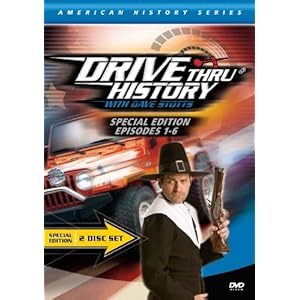
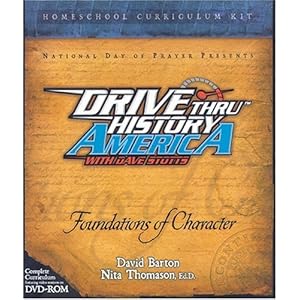
The Drive Thru History series with Dave Stotts, produced by ColdWater Media, is, as the cover suggests, history - fast and fun! Each DVD has three epidsodes that last about 30 minutes each, with the exception of the Foundations of Character series. These quirky, often silly, videos take you on location to several important historical sites and introduce you to many historical figures, famous and not-as-famous. Christian history is not left out and neither is the humor. Drive Thru History is definitely educational and equally entertaining.
This series, however, is not a history curriculum on its own. It should be used as a supplement to the history curriculum of your choice or just for fun! My boys and I laughed and giggled at the fake teeth, the car rolling down the hill, and the Pilgrim fashion show.
I recommend this series for ages 8 and up simply because some of the younger children may not get the humor. My sons are nine and twelve, and they love these dvds. Furthermore, if you like your children's education to be serious, don't bother buying this series!
 For more information, see www.drivethruhistory.com.
Drive Thru History (Ancient History)
Greece and the Word
East Meets West (Asia Minor)
Turkish Delight
Rome If You Want To
 Drive Thru History: American History
Columbus, The Pilgrims, and Early Boston
Soldiers, Jamestown, and Heroes of Virginia
New York, New Jersey, and Washington's Warriors
Patriots, Penn, and the Freedom Trail

Drive Thru History America: Foundations of Character (90 minutes)
Drive Thru History: Holy Land Series (Brand New)
Drive Thru History is from Focus on the Family and Tyndale Entertainment.
Both of my boys love science. When young, we would check out lots of books from our local library on a wide range of science topics. However, we found that many science textbooks for the elementary and early middle school ages are weak and boring. Fortunately, Apologia, well-known in the high school science market, now offers a science curriculum for elementary and middles schoolers that boasts strong science with a viewpoint that points to the Creator.
Jeannie K. Fulbright has authored six excellent books which delve into zoology, botany, astronomy, and human anatomy. Each book contains 13 or 14 chapters and can be used for ages 6-12, with modifications, of course. Notebooking journals are available for purchase, or you can print out pages from each course's free website. The textbooks are full of beautiful and interesting illustrations, activities, hands-on assignments, experiments, projects, and more. I highly recommend them because they are strong scientifically and yet Christian in viewpoint.
Below is a list of the Apologia books and how we have or will use them.
Exploring Creation with Astronomy -- When my oldest studied astronomy in 2nd or 3rd grade, I read this to him, and he created a lapbook. We used The Usborne First Encyclopedia of Space and The World of Space by Dinah Zike and Susan Simpson in conjunction with this book.
Flying creatures of the Fifth Day: Exploring Creation with Zoology 1 After completing the Zoology 3 book in our co-op, my son read this book and the Zoology 2 book on his own at home in his 7th grade year. He finished both books in about two and a half months. We did not do the activities, and I did not test him. He read for pure love of science.
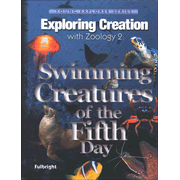
Swimming Creatures of the Fifth Day: Exploring Creation with Zoology 2 See above.
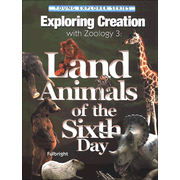
Land Animals of the Sixth Day: Exploring Creation with Zoology 3 This book was the core textbook for the zoology class my son took at our co-op his 6th grade year. They covered the book in a school year, covering 1 chapter every two weeks. In my opinion, for a 6th grader, this book can be covered easily in one semester.
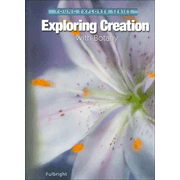
Exploring Creation with Botany This semester, I started this book with both boys (3rd and 7th grades), and I purchased the notebooking journals that accompany the textbook. I read a section aloud to the boys, and we work on the activities together. Due to a busy spring, we are working slowly. However, we built the suggested light hut and have lots of little plants growing inside waiting to be transplanted outside. If I can ever remember to buy the appropriate flower, we will do the flower dissection!
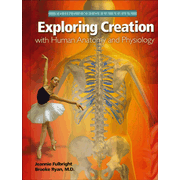
Exploring Creation with Human Anatomy and Physiology
I hope to do this book next with both boys, right after finishing botany. I purchased the Anatomy Notebooking Journal and the Junior Anatomy Notebooking Journal. Had I known that the Junior version had coloring pages added in, I would not have purchased it. If you child enjoys coloring (my third grader does not), then your child may like it.
****NOTE: For the month of March 2012, Apologia Elementary Science is 30% off at CBD. This is a GREAT deal.
Math. For me, like many homeschoolers, math was the one subject that caused much fear and trembling. Math was the subject I did not want to mess up.
For my oldest's kindergarten and 1st grade years, I used workbooks, fun games, and manipulatives to learn basic skills. However, concerned that I needed something that offered a strong foundation and built upon it, I began to research a variety of curricula. I ordered a free sample Math-U-See DVD, sat down to watch it, and on a lesson about multiplying fractions, I found light bulbs going off in my own head. I knew HOW but not WHY. Over the years, word problems were a thorn in the side. I could always get the math problems correct because I memorized how to do them but figuring out why was tricky for me. I had just figured out something I didn't know, and shortly thereafter, I purchased my first Math-U-See book of many.
Some math books cover wide ranges of topics a little -- they go wide. However, Math-U-See covers one topic from top to bottom-- it goes deep. For example, when learning multiplication, Math-U-See teaches all the multiplication facts, converting tablespoons to teaspoons, quarters to dollars, pints to gallons, quarts to pints, ounces to pounds, area of a rectangle, multiple digit multiplication, prime and composite numbers, solving for the unknown (division), etc. For the entire year, you learn everything there is to know about the skill of multiplication. In other curricula, you may learn some multiplication, some time, some fractions, some decimals, and some other math skills; they skim the surface of several different topics, and over the years, they are cumulative (which is a fine but different approach).
The program uses a great deal of manipulatives, even in the older grades, thus the name, Math-U-See. The hands on approach really worked for both of my boys and aided in their understanding. I have heard many say that Math-U-See is weak on word problems, but I have not found that to be the case. Perhaps later editions of the program have added more word problems.
My sons and I watch the DVD introducing a new lesson which takes 5-10 minutes. The "teacher" and creator of the curriculum, Steve Demme, is entertaining and clear. In the student book, there are three pages of lesson practice on the new concept and three pages of systematic review. We do not do every page; if the topic is mastered, we move on to the systematic review. On some lessons, we may do two lesson pages and two systematic review pages. In the pre-algebra book, there is an additional "Honors" page that my oldest son completes. Other than watching the videos with my sons and making flashcards of multiplication facts, I do not do any other preparation.
We are in our seventh year of using this curriculum, and I have been very pleased. In the fifth grade, my son scored 100% on the Iowa Tests of Basic Skills on both single-step and multiple-step word problems. Whew! I was so relieved! The curriculum offers clear instruction, lots of practice, systematic review to ensure mastery, and both single-step and multiple-step word problems for all concepts. I highly recommend Math-U-See.
Note: Because I was afraid that my children would not get a strong math background, in the early years, I forced my children to do every problem on every single page of their math books. A friend and math major told me that I needed to move on if the subject was mastered. If my boys do a good job on the first two pages of the new concept, we move on to the systematic review and then to a new lesson. This has made an INCREDIBLE difference in their attitude about math. It is no longer the dreaded and hated subject that it once was. Don't be afraid to skip pages. However, if your child needs that practice, by all means, do it. If they do not, move on. That's part of the beauty of homeschooling -- individualized instruction.
Thanks Leesa W. for the suggestion!
 When I was in high school, every history teacher I had wrote copious notes on the board which we were required to write in our notebooks, word for word, for a test grade. History was boring.
When I began homeschooling, I decided there must be more to this subject of history. I'd heard others say they love history. My husband loves history. Surely, I must be missing something.
Early on, I decided to teach history in chronological order because that made sense to me. Teaching about the Pilgrims followed by the Mayans followed by the Greeks seems ... well, out of order and confusing. Initially, I chose to use The Story of the World by Susan Wise Bauer. My oldest son and I enjoyed the book and the activity book. We checked out several recommended extra library books, made a Nubian costume, colored maps, and made all sorts of crafts. We got through the first 10 chapters out of 42 in our first year.
During this time, people were beginning to talk of a new book called The Mystery of History and how wonderful it was, but I was content with The Story of the World. After finishing volume 1, we began The Story of the World, Volume 2: The Middle Ages, but there was something missing. I purchased a copy of The Mystery of History: The Early Church and the Middle Ages and immediately switched.
The Mystery of History by Linda Hobar, like The Story of the World, is written in chronological order, is conversational, and has an activity guide. However, The Story of the World is meant to be a secular text, and The Mystery of History is unabashedly Christian. Once we came to the middle ages and the Reformation, understanding church history became necessary to understand any history of Europe at all. In Bauer's attempt to be secular, the history of the church and thus all of Europe at the time, was anemic. Also, I felt that Bauer's writing in her first book was markedly better than that of her second book (and I hear that her third and fourth are worse) and that the historical events were not in a strict chronological order, which drove me crazy. Finally, I believe The Mystery of History is more easily adapted for older students.
In the "Letter to the Teacher," Hobar writes, "I think one of the easier ways to 'know God better and to make Him known' is to first know the stories of Him found in history and the Bible from the beginning to the end! That to me is history. I believe history is the story of God revealing Himself to mankind and that He did it most perfectly through the person of Jesus Christ. For that reason, I call this course The Mystery of History, believing that the 'mystery' is the gospel of Jesus Christ." I agree, wholeheartedly, which is why I love this series; it is strongly Christian and yet strongly academic.
Some have complained that Hobar shares too many opinions and is too conversational, but my sons and I thoroughly enjoy her writing style. They look forward to reading history every day.
The book can be adapted for a variety of ages and has suggestions for doing so. The activity book has an excellent list of literature or other books to accompany this curriculum, broken up into categories for older, middle, and younger kids. There are tests, quizzes, activities, maps, and other fun ideas in the activity book as well. Timeline figures are available from Homeschooling in the Woods to make a timeline, or you can make your own pictures. We used the pre-made timeline figures for Volume 3, and I had my oldest make notecards with important points listed for each chapter. My youngest listened to the chapter with his brother and to any additional books, fact or fiction, that we chose to read to go along with the chapter.
Currently, The Mystery of History Volume IV is not written, so we have taken a break from world history and begun studying United States history. However, we anxiously await Hobar's next and last volume.
Finally, I believe, God used The Mystery of History: Volume III The Renaissance, Reformation, and Growth of Nations to reveal Himself more fully to my youngest son. In August 2011, we studied Lesson 71 about Blaise Pascal (1654). Pascal was a brilliant man who invented the first calculator, came up with Pascal's Law and Pascal's Theorem, and refined the Theory of Probabilities. However, unlike most history books, Hobar shares Pascal's testimony of how he trusted Christ as his Savior after losing control of his carriage and almost losing his life. His life was radically transformed, and he dedicated the rest of his life to Christian causes. It was during this lesson that Titus decided to trust Christ. As Hobar says, "history is the story of God revealing Himself to mankind and that He did it most perfectly through the person of Jesus Christ." Amen!
Oh, and by the way, I love history now. It's one of my favorites, as long as I'm not copying notes off a blackboard.