Showing posts with label Homeschooling. Show all posts

Tuesday, January 8, 2013

I Was Sad -- A BAD Paragraph: A Writing Lesson

     I am up to my neck in writing.  My head is swirling with thoughts about writing.  My brain is exploding with writing thoughts.  I have little scraps of paper everywhere.  They say things like, "Exposition -- what we do most" and "must PLAN" and "same persuasive letter -- 2 audiences" and "the best way to get better is to DO ie. piano, math, instrument, writing."  

     You see, this Friday, I begin teaching two writing classes to intermediate students at our homeschool co-op.

     Today, I typed up our first activity.  Sometimes the best way to teach a subject is to show the students what NOT to do.  I had so much fun with it that I had to share it with you!  Feel free to use it with your own students.

     Have the student read the paragraph out loud, and then do the activity at the bottom.


I Was Sad
By Mrs. Mullin
     I am supposed to write about a time I was sad recently.  Here goes,  Today, I took down my Christmas tree.  that made me sad.  I took off all the ownamants.  There weas a lot of them.  It was empty.  I looked at the tree.  It made me sad.  It was bare.  And plain.  Just green with lights.  Other people were watching football.  It reminded me that i have to wait a long time until christmas comes back.  Isn’t that sad?  No more family time.  My in-laws came for the holidays. No more free time.  School is starting back, too.  Oh, and the presents.  I have to wait to get more presents.  I can’t wait until my birthday in February.  So, that’s why I was sad recently.
January 7, 2013 
The End


This is a BAD paragraph.

*How many “sentences” are in this paragraph?  _______
*Circle any mistakes that you see.  (Grammar, usage, mechanics)
*Which sentences are completely random?  Write “random” boldly above them.
*Underline the fragments?  A fragment is not a complete sentence. 
*Create a better title.
*Rewrite the pitiful topic sentence: 


*In your group, rewrite this paragraph.  Combine sentences.  Eliminate random thoughts.  Expand sentences.  Add some interesting details.  Oh please – fix this paragraph!

Thursday, October 4, 2012

What Is Man that You Are Mindful of Him? Astronomy Lessons

     This semester I have the privilege of teaching astronomy to 27 third through fifth graders.  The last time I taught astronomy was about 5 years ago to my oldest son.  Coming back to the subject so many years later does not dull the awe that I feel every time I study the heavens.

Psalm 8
O LORD, our Lord, how majestic is your name in all the earth! You have set your glory above the heavens.  From the lips of children and infants you have ordained praise because of your enemies, to silence the foe and the avenger.  When I consider your heavens, the work of your fingers, the moon and the stars, which you have set in place,  what is man that you are mindful of him, the son of man that you care for him?  You made him a little lower than the heavenly beings and crowned him with glory and honor.  You made him ruler over the works of your hands; you put everything under his feet:  all flocks and herds, and the beasts of the field,  the birds of the air, and the fish of the sea, all that swim the paths of the seas.  O LORD, our Lord, how majestic is your name in all the earth!    


"Swirls of gas and dust reside in this ethereal-looking region of star formation seen by NASA's Hubble Space Telescope. This majestic view, located in the Large Magellanic Cloud (LMC), reveals a region where low-mass, infant stars and their much more massive stellar neighbors reside. A shroud of blue haze gently lingers amid the stars."  NASA.gov

Our galaxy, the Milky Way, is just one of an infinite number of galaxies in the universe.


The Milky Way contains 200 - 400 billion stars.  
Our Sun is just one of those stars.


Our Sun is a medium-sized star.


One million of our Earth's would fit inside 
our medium-star-sized Sun.


When I consider your heavens, the work of your fingers, 
the moon and the stars, which you have set in place,  
what is man that you are mindful of him, 
the son of man that you care for him? 
Psalm 8:3-4

Yes, what is man that You are mindful of him?  
We are but tiny specks in the vast universe 
and yet God knows us, loves us, and sent His Son to die for us.  
Your name, O LORD, is truly majestic!


All photos from www.nasa.gov
Credit: NASA, ESA, and the Hubble Heritage Team (STScI/AURA)-ESA/Hubble Collaboration

Monday, October 1, 2012

My Purposeful-specific-quality-inducing-praise Experiment

     I've been reading lately about praising your children, and I realize that I am very, very good at pointing out what my kids do wrong.  However, knowing that praise is a good thing, I try to praise my kids as much as possible.  After some of my reading in the last few months, I wonder if I'm doing more harm than good.  Read on.  
     There are studies out that show giving children unspecific, random praise, such as "Awesome.  Good job!  Excellent.  Way to go," can actually harm their success in life. (The Praise Paradox: Are We Smothering Our Kids in Kind Words? and Can You Praise Your Child Too Much?)  For example, saying "You're so smart," all the time actually conditions them to want to give up easier when trying something hard because they automatically assume they are no longer smart if the answer doesn't come easily.  However, praising children about their hard work and perseverance even when things are tough makes them desire to keep on trying even if the test or task is hard and frustrating.  
     Also, I have been reading about praising children intentionally for the qualities you desire to see growing in them and finding those nuggets of greatness among their bad behaviors.  What qualities do you want to see in your child?  Do you want him to be cooperative, patient, respectful, helpful, humble, kind, grateful, and selfless?  Do you desire your child to honor authority figures, choose good friends, manage time well, avoid temptation, exhibit self-control, and handle rejection appropriately?  Do you want your child to persevere, share, and express thankfulness?  If so, choose to see their successes in these areas, no matter how small, and specifically praise them for those qualities instead of only pointing out their failures.  No matter how small the success, praise them for the characteristics you want to develop in your child.  This type of "praising" takes thought and a plan.  What do I want to see developed in my child?  Then, you must go about seeking, actively, to see and praise those attributes.
     On the flip side, the argument goes that parenting a child ONLY when he or she has done something wrong is parenting in the negative.  When our child comes to the table  right away when called to dinner, then we say.... nothing.  When our child ignores us and continues to play even when called, then we lecture about the necessity of obedience.  If our child shares like he's supposed to, we may say, "Good job sharing" or not.  If he refuses to share, well, we go after it.  The point is to try to also parent in the positive moments.  
     I've been mulling this over for a while now, and I think I want to try this method of praising my children and see what happens.  Here are some examples of the way I used to praise my children (1) and the way I hope to try doing it (2).  I call it my purposeful-specific-quality-inducing-praise-experiment. 

1.  I love to see you reading!
2.  I like the way you came over and began reading your book.  Reading is such an important skill, and I'm glad you see how important it is.  You are really showing wisdom!

1.  Good job starting your school work.
2.  I like the way you started your school work without complaining.  You are showing responsibility and hard work.  I appreciate that.

1.  You are a great piano player.
2.  Your piano playing has really improved because you have worked so hard.  I appreciate the way you have listened carefully to your teacher and made the necessary corrections.  That shows maturity.  You are really growing up!

1.  Wow!  You ate all your dinner without complaining.
2.  Thank you for eating your dinner without complaining, even though some of the food was not your favorite.  It shows a lot of self-control not to complain, and I like that you have decided to make healthy choices for your body.  Good job!

1.  You got a great grade on that test! You are so smart!
2.  You really studied for that test and your hard work and perseverance paid off!  You did your best, and it shows!  I am proud of you.

1.  Good job at the store today.
2.  That line at the grocery store was really long, but you were so patient.  I like the way you helped me unload the cart.  What a good helper you are.  I am blessed to have a helper like you.  

The toughest is turning something really negative into a positive.
1.  You would've been done with your math by now if you hadn't been fussing and complaining so much.  You lose your Wii time for the day!  (Imagine angry face!)
2.  That math was hard, and you got really frustrated.  You showed great self-control by calming down quickly and then getting that math problem done.  Way to stick it out and work hard.  (I actually did this after my youngest son got so frustrated with a math problem that he threw his pencil all the way across the table.  I sat silently until he calmed down, picked up his pencil, tried again, and completed the problem correctly.  Then I gave him the above praise.  His reaction to this praise was absolutely amazing.  At first he was stunned and looked at me quizzically, expecting the number 1 above response, and then he gave me a huge hug.  Hmmm... maybe there is something to this.)


     At the bare minimum, it makes sense to me to praise the qualities and characteristics that I want to see in my kids WHEN I see them.  We'll see how this goes...


Friday, August 17, 2012

The Wondrous Things of God: Life Cycle of the Monarch Butterfly

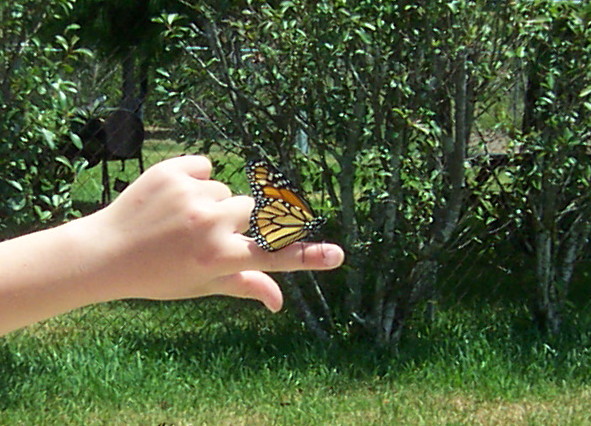
     There is something truly amazing about an egg the size of a pen point containing an itty-bitty caterpillar that will eventually become a monarch butterfly.  I never tire of watching the process and have multiple milkweed plants surrounding my house.  Only a majestic and wondrous God could come up with such an awesome process.  Really.  
     I have seen a caterpillar, early one morning, hanging upside down in his 'J,' transform into a chrysalis.  It's like his old body literally turns inside out, and in a matter of seconds, he is a wet, green, gold-flecked chrysalis.  In about 10 days, the chrysalis blackens, and then you can see the wings inside.  Finally, he pulls himself out, wet, dripping, and shriveled, but after a few more hours, he takes to the wind, a beautiful orange butterfly.  Amazing.  Beautiful.  Wonderful.  I never tire of it.


2 Corinthians 5:17
Therefore, if anyone is in Christ, he is a new creation.
The old has passed away; behold, the new has come.

Tuesday, July 31, 2012

Introduce Your Kids to Classical Music the Fun Way: Classical Kids CDs

     If you want to introduce your kids to classical music in a fun and interesting way, try the Classical Kids series.  The Classical Kids series introduces kids to composers and their music through dramatized, interesting stories.  Children will learn about the composer's life and work while his music plays in the background.  
     Our absolute favorite is Beethoven Lives Upstairs:  A Tale of Genius and Childhood.  This story chronicles a young boy with twin sisters who is grieving the loss of his dad.  Beethoven moves upstairs in his father's old office.  The boy corresponds with his uncle about Beethoven's demanding, erratic behavior, but in the end, the boy learns to care for Beethoven and his quirkiness.
     Another favorite is Song of the Unicorn:  A Musical Journey Through Medieval Times.  This one is a Merlin tale featuring Jeremy Irons, playing more than two dozen exerpts from the pre-Baroque era.  There are Gregorian chants, Celtic songs, and traditional English songs.  In this story, a young prince and princess must journey deep into the forest to find a unicorn to save their sick mother while avoiding Morgan-le-Fay who wants the unicorn for the power it will give her.
     In Vivaldi's Ring of Mystery:  A Tale of Venice and Violins, young orphan Katarina arrives at the orphanage where Vivaldi is the music director, accidentally breaks a treasured violin, and ends up searching throughout Venice for clues to her past.
     We own eight out of the ten in this series.  We also own:  
*Mozart's Magic Fantasy:  A Journey Through "The Magic Flute"  (Introduces children to opera.)
*Tchaikovsky Discovers America:  A Tale of Courage and Adventure
*Hallelujah Handel:  A Tale of Music and Miracles (features Katarina from Vivaldi's Ring of Mystery)
*Mozart's Magnificent Voyage:  Tales of the Dream Children
*Mr. Bach Comes to Call:  An Adventure in Time and Space


We do not own A Classical Kids Christmas and Daydreams & Lullabies.


     We often listen to these CDs while in the car on the way to the museum, the zoo, or any other location that is about 30 minutes away.  Each CD is about 45 minutes long.  


     I highly recommend this series for all ages because, quite frankly, I like them, too, and it's fun to hear a song, later, and recognize it.

Tuesday, July 24, 2012

Are All Teenagers Bad?

     A few years ago, my oldest son and I had a conversation about teenagers.  I'm not sure how it came up or what we were talking about, but I remember vividly this comment:  "Well, that's because they're teenagers, and teenagers do stuff like that because they're, well, bad."  I looked him squarely in the eye and said, "Son, you will be a teenager in a few years, and on the day you turn 13, you will not magically turn 'bad.'"  Thus began our children's education on the nature of teenagers because teenagers are NOT all bad.
     However, for some reason, teenagers have gotten a bad rap.   Society has told us that the teenage years are filled with anger, sullenness, rebellion, and irresponsibility.  Teenagers are considered lazy,  mouthy, morally irresponsible, and incapable of being well-adjusted. Is it possible that we get what we expect?  Somewhere along the line, did we allow moodiness and hormones to become an excuse for bad behavior?  Do we expect the worst and so we get it.  "Oh, he's a teenager.  What do you expect?"
     I expect that my son is not going to be that kind of kid, that's what!
     Benjamin Franklin became an apprentice to his half-brother at the age of 12.  At age 17, he left his brother, a printer, and ran away to Boston.  He got a job working for a printer, went to London, published an almanac, retired at age 42, studied electricity, invented things, became a politician, and helped found our nation.  Today, a seventeen year old is still considered a "baby."  When I married at 22, everyone said, "Why are you getting married?  You're still a baby."  When I was teaching high school at age 22, I was told I was a baby.  What have we done turning 22-year-olds into babies?
     Recently, our church held VBS with about 200 children attending and about 60 workers.  Many of those workers were teenagers.  Our youth pastor told the kids that society portrays teenagers as incapable and with that many teenagers helping VBS, something was bound to go wrong.  However, because of them not in spite of them, VBS went well.  They did a good job, and they should be proud.  This "speech" made an impression on our son, and I want to say, for the record,  "AMEN!"  Teenagers are not all bad.
     So what does the Bible say about youth and teenagers?


Don't let anyone look down on you because you are young, but set an example for the believers in speech, in life, in love, in faith and in purity.   1 Timothy 4:12  (NIV)


When I was a child, I talked like a child, I thought like a child, I reasoned like a child.  When I became a man, I put childish ways behind me.  1 Corinthians 13:11  (NIV)  Notice here that there is no in between age filled with angst and irresponsibility.  Paul does not say, "And when I was a teenager, I was an irresponsible rascal and talked back to my mother."
     
13I write to you, fathers, because you have known him who is from the beginning. I write to you, young men, because you have overcome the evil one. I write to you, dear children, because you have known the Father.  14  I write to you, fathers, because you have known him who is from the beginning. I write to you, young men, because you are strong, and the word of God lives in you, and you have overcome the evil one.  1 John 2:13-14  (NIV)  (Underlining is mine.)
     Let's start teaching our children that young men and women, otherwise known as teenagers, can be an example for other believers, can put childish ways behind them, can be strong in the Lord because the word of God lives in them.  Teenagers can be self-disciplined, self-controlled, responsible, dependable, and hard-working.  Teenagers can make a difference in this world for the Lord, so let's start treating them that way.
     Oh, and by the way, my oldest son turned thirteen in May, and I am proud to report that at this very moment, he is helping his father unload a moving truck for a single mother and her two children.  Why?  Because teenagers are NOT all bad!  


     For further reading, Dr. David Alan Black wrote a book called:  The Myth of Adolescence: Raising Responsible Children in an Irresponsible Society.  However, I believe this book is out of print.  He wrote an article summarizing his beliefs called Want to Reform Your Youth Ministry? Reject Adolescence!  


     The authors of Do Hard Things, Alex and Brett Harris, have a wonderful blog.  These articles on the Myth of Adolescence are excellent!  
The Myth of Adolescence Part 1 and The Myth of Adolescence Part 2

     Finally, Sheila Wray Gregoire wrote an excellent blog post called The Curse of Low Expectations for Teens.

Monday, June 11, 2012

Tasty Science: Homemade Vanilla Ice Cream in a Ziploc Bag

     Here is a FUN activity and lesson that I did a while back.  I'm sharing it with you to do with your children this summer -- along with some history and science!  The end result is yummy ice cream!


READ:  Should I Share My Ice Cream by Mo Willems


HISTORY:  No one knows when ice cream was invented.  About 3,000 years ago, the Chinese mixed rice, snow, and milk together to make a tasty treat.  In Persia, about 400 BC, people would pour grape juice on snow and eat it when it was hot outside.  The Emperor Nero had ice and snow brought to him in Rome to eat with fruit juice.  It seems that the Arabs were the first to use milk to make ice cream sweetened with sugar.  In the 10th century, many cities in the Arabic world such as Baghdad, Damascus, and Cairo produced ice cream with milk, cream, or yogurt and flavored it with rosewater, dried fruits, and nuts.
     Here in America, the British brought ice cream to the American colonies about 300 years ago, but only the wealthy could eat it because ice was very rare and expensive.  In the 1840s, Nancy Johnson from New Jersey invented a hand-cranked ice cream maker, and the rest is history!

THE SCIENCE of ICE CREAM:
How does it happen:
  • Milk can change from a liquid to a solid with the help of ice and salt.
  • It involves the exchange of heat.
  • Cold does not exist by itself. It is simply the absence of heat.
  • For example, a cold room is cold because some of its heat energy has escaped.
  • Heat energy goes from places with more heat energy to places with less.
  • The milk mixture has more heat energy than the salt and ice does.
  • Therefore, heat energy goes from the milk mixture to the ice and salt.
  • The milk mixture lost heat energy, which caused it to cool and freeze, eventually becoming ice cream, a solid.
  • The ice gained heat energy, which caused it to melt, eventually becoming salt water, a liquid.
  • When you add salt to the ice, it lowers the freezing point of the ice, so even more energy has to be absorbed from the environment in order for the ice to melt.  This makes the ice colder than it was before.
  • So the addition of salt lowers the freezing temperature, which causes the ice cream to freeze sooner.
  • If you do not add the salt, the mixture will get cold but only as cold as the ice – so it will be more like a thin milkshake.
TRY THIS:  Put ice and water in two cups.  Add salt or rock salt to one.  Stir.  Take the temperature of both.  Which is colder?

REVIEW of THE SCIENCE of ICE CREAM:
  • So….The ice cream mixture is about 32 degrees.
  • The salt-ice mixture is below 32 degress.
  • Heat flows from warmer to cooler objects, so the energy from the ice cream mixture flows to the salt-ice mixture.
  • The ice cream mixture gets colder, and the salt-ice mixture begins to melt.


MAKE ICE CREAM:

Materials:
Large gallon size ziploc/re-sealable bag
2 Quart sized ziploc/re-sealable bags
1 cup half and half
½ to ¾ teaspoon Vanilla
2 tablespoons Sugar
½ to ¾ cup Rock salt
Ice 


STEP 1. Carefully pour the half and half, vanilla and sugar into one of the small bags. Seal tightly, squeezing out as much air as possible.
STEP 2. Place the bag with the mixture inside the other small bag and seal it, leaving as little air as pos­sible.
STEP 3. Place the ice inside the one-gallon re-sealable bag.
STEP 4. Place the two small bags containing the mixture inside the larger bag with the ice. Make sure the ice surrounds the bags with the cream mixture.
STEP 5. Sprinkle the salt over the ice in the larger bag.
STEP 6. Seal the larger bag, letting as much air escape as possible.
STEP 7. Wear gloves or wrap bag in a towel.
STEP 8. Shake and massage the bag for approximately 15-20 minutes.  
STEP 9.  Remove small bags from the large bag, open, and eat!  (Be careful not to get salt in the ice cream.  You may want to rinse off the bag in the kitchen sink before opening it.)


SOURCES:  
*History of Ice Cream,  Wikipedia 
*Ice Cream:  The Full Scoop by Gail Gibbons
*http://www2.gi.alaska.edu/STEP/lessons_database/lessons/acmp/acmp_58_MeltingTheIce.pdf


Monday, June 4, 2012

Shoe Tying 101

     I do not remember teaching my oldest son how to tie his shoes.  I know we did because he does it on his own every day.  However, I don't remember how old he was nor how or when we did it.  With my youngest son, the process was much more difficult and therefore, memorable.  My youngest lacks fine motor skills and loves velcro so I knew shoe-tying was not going to be fun.  This is how we did it.


     We started with a 1/2 inch wide ribbon and his favorite stuffed animal.  On the first day, I showed him how to tie a bow on the neck of his stuffed penguin.  The next day and for many days after that, I helped him make a bow, slowly and step-by-step, trying to use the same words and steps every time.  We tied bows on different stuffed animals once a day about 4 days a week for several months.  


     After he mastered stuffed-animal-bow-tying, we moved on to a new pair of shoes -- the ones he would wear when he grew out of his velcro-tennis shoes.  I sat the shoe in front of him while he sat on the floor (as if it were on his foot).  I showed him how to tie a bow on this tennis shoe.  He practiced on this shoe for a few months.  (I added "Shoe Tying" on his checklist for school.)


     Once he got shoe-tying-on-a-new-shoe-that-is-not-on-the foot down, we put the single shoe on his foot and practiced tying it.  We did this for a month or so.


     One day, he could not wear his old shoes because it was raining.  He had put off wearing those new shoes for so long that there were holes in the bottoms and sides of his velcro shoes.  Alas, he had to wear his new shoes.  It took a while, but he tied those new shoes!


     We still practice once or twice a week, just to stay in practice.  It's sandal season here, and he loves his velcro, but he can finally tie his shoes!


Tuesday, May 29, 2012

Homeschooling: What if I Miss Something? Find Your Own Way

     I taught public high school English in the state of Virginia where we had to abide by the Virginia Department of Education's Standards of Learning or SOLs.  When I lived in North Carolina, the standards were in a state of flux because of low test scores.  In Tennessee, when I began homeschooling my then-kindergarten son, I printed out a copy of what kindergartners should know by the end of the year from the Tennessee Department of Education's website and a copy of a kindergarten report card that a teacher in my church sent me.  When I moved to Texas, I printed out the Reading Grade 4 and Science Grade 5 2008 versions of the TAKS test.  A few months ago, I printed out the Texas High School Graduation Requirements. There is a fear that lurks within the homeschooling parent that somehow, we are going to miss something, and even though we have chosen to forgo public education, there is a nagging doubt that maybe, just maybe, we should follow what the public schools do, just in case.  
     What if I miss something?  What if I screw something up?  What if he grows up being bad at math?  What if she's not prepared for college?  What if.....?
     After living in four states with four different standards of educational achievement for children, I came to realize something:  Every state is different, and I need to find my own way.  So how do you do that?


1.  Let go of the fear.
     How many holes do you have from your own education?  For me, I went through high school and learned very little history.  Were you bad at math or writing?  If so, then it's ok for your child to have struggles, too.  It doesn't mean you're doing a bad job educating your children.


2.  Decide how you are going to educate your child -- your way.
You have to say, "I'm not educating the state of Texas' way; I'm doing it my way."  Then, figure out what that way is:  classical, traditional, eclectic, etc.  It's totally all right to check what a state is doing and requiring, as long as it is just another tool in your toolbox and not a chain around your neck.


3.  Treasure the freedoms you do have in homeschooling.


*The freedom to create something that looks different -- reading books together in your living room, drawing pictures of monocots and dicots in your front yard, eating lunch together every day, buying and feeding a Venus Fly Trap -- you are creating something different.  


*The freedom to wait until your child is ready.  For me, my son was not ready to write essays in the fourth grade.  As a seventh grader, he's doing great in this area.  However, fourth graders, especially boys, seem to end up hating writing after "testing" for it.  Homeschooling gives you the freedom to wait.


*The freedom to tailor to kids' likes and passions.  My oldest went through a reptile and dinosaur phase.  My youngest did a unit study on penguins.  Study what they love.


*The freedom to co-educate.  I am able to do history and science with both of my boys together, and they do a book called Vocabulary Cartoons together, with my oldest teaching the youngest.  This gives them common experiences and good times together.


*The freedom to do more.  I believe we have covered more history more deeply than most public schools. 


*The freedom to be flexible.  We are able to go to Florida for a World FLL Invitational or to visit grandparents in October.  (We also have the freedom to finish school at the end of June!)


*The freedom to fill in the holes as you see them.  Who cares about your kids' education more than you?  If you see holes, then you can take the time to research strategies and to give your child one-on-one help for any problems he or she may be having.  Also, for us, I realized my son knew too little about how our government works, so I checked out books from the library on the three branches of government and had him read them on his own.  Recently, he asked me to get him some books on World Wars I and II because he felt he should know more.  (Yikes!  I need to do that!)


*The freedom to teach them how to learn.  When my husband was getting his PhD at Vanderbilt University, he knew a young man who was 20 years old and getting his master's degree (and later applied and was accepted to the PhD program at the age of 22.  He finished his PhD at age 27.)  He had been homeschooled his entire educational career.  I asked him what the key to his educational success was -- what should I make sure I teach my boys.  He didn't say math or science or writing.  He said, "Teach them HOW to learn."  He went on to explain that many people his age simply do not know how to educate themselves about what they do not know.  Facts are not as important as learning how to FIND facts.  We just studied Benjamin Franklin, who was in school for only three years, and then educated himself.  Teach them how to use a library, read books, find answers, be curious.  Teach them how to learn.


*The freedom to teach things that only you can:  Christian values, how to get along as a family, life skills, etc.


Public school standards can be a great guide, but don't let those standards squelch your freedoms.  


     My two sons are in the 7th and 3rd grades.  I have not taught them Texas history yet.  As Mr. Incredible says, "We'll get there when we get there!"  I plan to get there, but not when the public schools say I should, and that is OK.


NOTE:  This is meant to be encouraging for those who feel called to homeschool.  I am in no way critiquing public school choice or those who work tirelessly in the classroom.  I believe strongly that we all should pray and do what God has called us to do in the area of educating our children.

Tuesday, April 24, 2012

Phil Vischer presents What's in the Bible? -- A Review

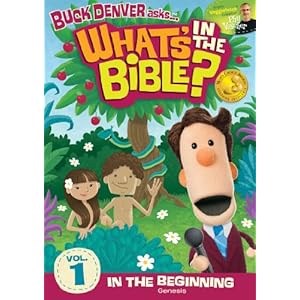
     Phil Vischer of VeggieTales fame has created a new series that is loads of fun with a heavy dose of theology -- all for kids.  What's in the Bible? uses live animation and puppets to combine good, solid Bible teaching and storytelling in a quirky, silly, fun way that appeals to adults and kids alike.  These DVDs are designed to survey the entire Bible from beginning to end. Volumes 1-7, In the Beginning (Genesis) through Exile and Return (Ezra, Nehemiah, Esther), have been released so far.
     The cast of characters include:  Chuckwagon, the singing cowboy, The Sunday School Lady who is NOT as old as the OLD testament, Michael, the kid in the car watching the DVD (‎"I’ve got a question! Why are they called 'testa-mints?' Do they give you fresh breath? Because I licked one and it didn’t work." -Michael, age 8), Brother Louie, Buck Denver, 2 old ladies who remind you of the old guys on the Muppet Show, and many more.  Every character, from my understanding, is performed by Phil Vischer himself.
     Two of my favorite special segments include:  the Pirates Guide to Church History -- you know about Jesus and Billy Graham; well, the pirate fills in the stories in the middle, and the Popsicle Stick Theater -- where God is a cloud because a heart makes God look like a Valentine and fire is too scary.
    According to the very first segment on Volume 1, the Bible tells the story of God and what He's done for us, making the Bible the world's most important book.  From that point on, Phil takes two things very seriously:  teaching children Bible truths and having loads of laughs.
     Just so you can have a taste of what these videos are like, Volume 1:  In the Beginning, answers the following questions:  


*Why do Orthodox and Catholic Bibles have more books than the Protestant Bible?
*What does inspired mean?
*How can we trust the books of the Bible if we don't know who wrote them?  (Because God inspired the process AND the writing)
*How old is the Earth?  Who is right?  ("We don't know, and sometimes that's ok.  The Book of Genesis wasn't written to tell us the HOW of creation but the WHO of creation. 'In the beginning God created the heavens and the earth.'" -- Phil Vischer)
*What is sin?
*Why didn't God just change the rules so Adam and Eve could be with Him again?


     These are just a few of the questions that get answered in 25 minutes, but the real kicker is that you will hear the answers to these tough questions while giggling and cracking up at the puppet's antics.  I can't think of a better way to learn what's in the Bible, can you?


     To learn more, visit whatsinthebible.com.


Tuesday, April 10, 2012

Drive thru History with Dave Stotts: History - Fast and Fun!

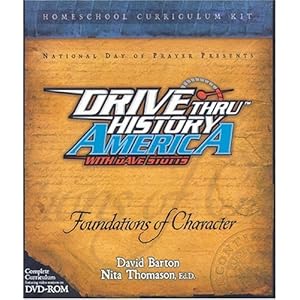
     The Drive Thru History series with Dave Stotts, produced by ColdWater Media, is, as the cover suggests, history - fast and fun!  Each DVD has three epidsodes that last about 30 minutes each, with the exception of the Foundations of Character series.  These quirky, often silly, videos take you on location to several important historical sites and introduce you to many historical figures, famous and not-as-famous.  Christian history is not left out and neither is the humor.  Drive Thru History is definitely educational and equally entertaining.
     This series, however, is not a history curriculum on its own.  It should be used as a supplement to the history curriculum of your choice or just for fun!  My boys and I laughed and giggled at the fake teeth, the car rolling down the hill, and the Pilgrim fashion show.  
     I recommend this series for ages 8 and up simply because some of the younger children may not get the humor.  My sons are nine and twelve, and they love these dvds.   Furthermore, if you like your children's education to be serious, don't bother buying this series!


     For more information, see www.drivethruhistory.com.  


Drive Thru History  (Ancient History)
Greece and the Word
East Meets West  (Asia Minor)
Turkish Delight
Rome If You Want To


Drive Thru History:  American History
Columbus, The Pilgrims, and Early Boston
Soldiers, Jamestown, and Heroes of Virginia
New York, New Jersey, and Washington's Warriors
Patriots, Penn, and the Freedom Trail


Drive Thru History America:  Foundations of Character  (90 minutes)


Drive Thru History:  Holy Land Series  (Brand New)


Drive Thru History is from Focus on the Family and Tyndale Entertainment.


Tuesday, March 20, 2012

Seven Lies about Homeschoolers -- A Funny Video

     This is funny because it is true.  I get asked some of the strangest questions, and some people think we are just plain weird.  Aren't we all, though?
     For the record, we do not homeschool in our pajamas, we do not finish at lunchtime, and I absolutely REFUSE to allow my children to wear pants that are too short!  I'm just sayin'.  
     However, I would love to live further from the Wal-mart and a log cabin might be cool!


Monday, March 5, 2012

Apologia Elementary/Middle School Science -- Strong Science for Ages 6-12

     Both of my boys love science.  When young, we would check out lots of books from our local library on a wide range of science topics.  However, we found that many science textbooks for the elementary and early middle school ages are weak and boring.  Fortunately, Apologia, well-known in the high school science market, now offers a science curriculum for elementary and middles schoolers that boasts strong science with a viewpoint that points to the Creator.  
     Jeannie K. Fulbright has authored six excellent books which delve into zoology, botany, astronomy, and human anatomy.  Each book contains 13 or 14 chapters and can be used for ages 6-12, with modifications, of course.  Notebooking journals are available for purchase, or you can print out pages from each course's free website.  The textbooks are full of beautiful and interesting illustrations, activities, hands-on assignments, experiments, projects, and more.  I highly recommend them because they are strong scientifically and yet Christian in viewpoint.
     Below is a list of the Apologia books and how we have or will use them.


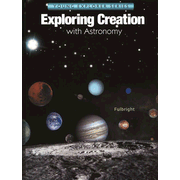
Exploring Creation with Astronomy -- When my oldest studied astronomy in 2nd or 3rd grade, I read this to him, and he created a lapbook.  We used The Usborne First Encyclopedia of Space and The World of Space by Dinah Zike and Susan Simpson in conjunction with this book.


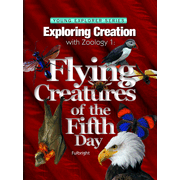
Flying creatures of the Fifth Day:  Exploring Creation with Zoology 1    After completing the Zoology 3 book in our co-op, my son read this book and the Zoology 2 book on his own at home in his 7th grade year.  He finished both books in about two and a half months.  We did not do the activities, and I did not test him.  He read for pure love of science.


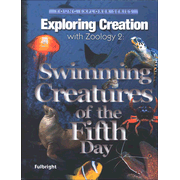
Swimming Creatures of the Fifth Day:  Exploring Creation with Zoology 2  See above.


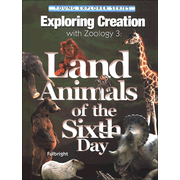
Land Animals of the Sixth Day:  Exploring Creation with Zoology 3   This book was the core textbook for the zoology class my son took at our co-op his 6th grade year.  They covered the book in a school year, covering 1 chapter every two weeks.  In my opinion, for a 6th grader, this book can be covered easily in one semester.


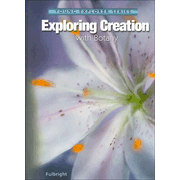
Exploring Creation with Botany  This semester, I started this book with both boys (3rd and 7th grades), and I purchased the notebooking journals that accompany the textbook.  I read a section aloud to the boys, and we work on the activities together.  Due to a busy spring, we are working slowly.  However, we built the suggested light hut and have lots of little plants growing inside waiting to be transplanted outside.  If I can ever remember to buy the appropriate flower, we will do the flower dissection!


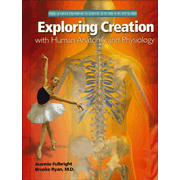
Exploring Creation with Human Anatomy and Physiology  
I hope to do this book next with both boys, right after finishing botany.  I purchased the Anatomy Notebooking Journal and the Junior Anatomy Notebooking Journal.  Had I known that the Junior version had coloring pages added in, I would not have purchased it.  If you child enjoys coloring (my third grader does not), then your child may like it.  


****NOTE:  For the month of March 2012, Apologia Elementary Science is 30% off at CBD.  This is a GREAT deal.  

Tuesday, February 21, 2012

A Day at Mullin Academy

     Recently, many people have asked me about our daily schedule.  Since today was fairly typical with no appointments or other interruptions, I decided to write everything down.  For those of you who are curious, here's a sample day at Mullin Academy.
     My goal is to start school by 9:00 a.m.  Today, we ran a bit behind.  My oldest went to Collide at our church, a youth event, where he stayed up late Friday and Saturday nights, and he was still recuperating, and my youngest and I have been battling colds.  We were all dragging this morning.  Before school begins, the boys get dressed, make beds, eat breakfast, and brush teeth.


Tuesday, February 21, 2012
9:30-12:15  School
Third grade son -- 30 minutes of independent reading, Math page 22D, sit ups, push ups, stretches (preparing for Presidential Physical Fitness challenge at our co-op), skill book (long 'a' review), shoe tying practice, spelling test 23, piano practice
Seventh grade son -- Piano practice, independent reading, read ScienceSaurus 15 minutes, grammar, creative writing homework for our co-op (writing a poem about how a pencil feels to be sharpened from the pencil's point of view -- I teach his creative writing class), reviewed 25 Latin vocabulary words
Me -- During youngest son's independent reading, I started a load of laundry, ate breakfast, tidied the kitchen, checked e-mail, and got ready for the day.  After that, I helped my youngest with the rest of his work, and  I made lunch while he practiced piano.


12:15 - 12:40  Lunch -- homemade beanie weanies, hotdogs, apples, cheese bits (My oldest ate 2 hot dogs, a bowl of beanie weanies, half an apple, and cheese bits!  Yikes!  He's only 12!)


12:40-1:00 Clean-Up Time
Youngest-- made bed (he was supposed to earlier), cleaned up Legos and Hexbugs in the living room, folded washcloths
Oldest -- unpacked Collide suitcase, got out laundry from dryer, put load from washer to dryer, sorted socks and put them away
Me -- Put a load of laundry away, folded undershirts, cleaned up table from lunch


1:00 - 2:00  Reading Time -- Everyone Together
I read to both boys in the living room.
1.  History:  A History of US:  Making Thirteen Colonies 1600-1740 by Joy Hakim, Chapter One
2.  Read Aloud:  Imprisoned in the Golden City:  Adoniram and Ann Judson by Dave and Neta Jackson  (about American missionaries to Burma in the 1800s)
3.  Science:  Exploring Creation with Botany by Jeannie K. Fulbright p. 43-44  Carnivorous Plants:  The Venus Flytrap Family and The Bladderwort Family
4.  For their spies class at our co-op, I read:   Traitor:  The Case of Benedict Arnold by Jean Fritz  p. 70-80  (We are reading the entire book aloud.  Both boys take a SPIES class at our co-op, and they are assigned two chapters a week.)


2:00  Snack and Coffee/Hot Chocolate -- because I REALLY needed coffee, and my boys are always hungry.
After snack, more school.
Youngest --  studied AWANA verses, read to mommy Third-Grade Detectives #3:  The Mystery of the Hairy Tomatoes by George E. Stanley Chapter Two (I continue to have him read aloud to me so I can check for errors or concerns.  Also, this aids fluency.), Phonics Pathways by Dolores G. Hiskes p. 184, Sheppard Software (online):  Geography -- countries of Asia and Rivers of the US (while I watched math video with oldest because I need to watch it now that he's doing pre-algebra), Basketball -- shot 45 baskets  
Oldest --  Corrected math test from yesterday, watched pre-algebra math DVD Lesson 14, did math page 14A, 10 minutes reading The Real Benedict Arnold by Jim Murphy, studied and recited Psalm 46:1-3, spelling page, Basketball -- shot 60 baskets


Third grade son finished at 3:50.
Seventh grade son finished at 4:20.


Whew!  There you have it -- that's our school day!  Questions?  Comments?  Surprised that we don't finish at lunchtime?  Feel free to tell me about YOUR homeschooling day!