Monday, June 11, 2012

Tasty Science: Homemade Vanilla Ice Cream in a Ziploc Bag

     Here is a FUN activity and lesson that I did a while back.  I'm sharing it with you to do with your children this summer -- along with some history and science!  The end result is yummy ice cream!


READ:  Should I Share My Ice Cream by Mo Willems


HISTORY:  No one knows when ice cream was invented.  About 3,000 years ago, the Chinese mixed rice, snow, and milk together to make a tasty treat.  In Persia, about 400 BC, people would pour grape juice on snow and eat it when it was hot outside.  The Emperor Nero had ice and snow brought to him in Rome to eat with fruit juice.  It seems that the Arabs were the first to use milk to make ice cream sweetened with sugar.  In the 10th century, many cities in the Arabic world such as Baghdad, Damascus, and Cairo produced ice cream with milk, cream, or yogurt and flavored it with rosewater, dried fruits, and nuts.
     Here in America, the British brought ice cream to the American colonies about 300 years ago, but only the wealthy could eat it because ice was very rare and expensive.  In the 1840s, Nancy Johnson from New Jersey invented a hand-cranked ice cream maker, and the rest is history!

THE SCIENCE of ICE CREAM:
How does it happen:
  • Milk can change from a liquid to a solid with the help of ice and salt.
  • It involves the exchange of heat.
  • Cold does not exist by itself. It is simply the absence of heat.
  • For example, a cold room is cold because some of its heat energy has escaped.
  • Heat energy goes from places with more heat energy to places with less.
  • The milk mixture has more heat energy than the salt and ice does.
  • Therefore, heat energy goes from the milk mixture to the ice and salt.
  • The milk mixture lost heat energy, which caused it to cool and freeze, eventually becoming ice cream, a solid.
  • The ice gained heat energy, which caused it to melt, eventually becoming salt water, a liquid.
  • When you add salt to the ice, it lowers the freezing point of the ice, so even more energy has to be absorbed from the environment in order for the ice to melt.  This makes the ice colder than it was before.
  • So the addition of salt lowers the freezing temperature, which causes the ice cream to freeze sooner.
  • If you do not add the salt, the mixture will get cold but only as cold as the ice – so it will be more like a thin milkshake.
TRY THIS:  Put ice and water in two cups.  Add salt or rock salt to one.  Stir.  Take the temperature of both.  Which is colder?

REVIEW of THE SCIENCE of ICE CREAM:
  • So….The ice cream mixture is about 32 degrees.
  • The salt-ice mixture is below 32 degress.
  • Heat flows from warmer to cooler objects, so the energy from the ice cream mixture flows to the salt-ice mixture.
  • The ice cream mixture gets colder, and the salt-ice mixture begins to melt.


MAKE ICE CREAM:

Materials:
Large gallon size ziploc/re-sealable bag
2 Quart sized ziploc/re-sealable bags
1 cup half and half
½ to ¾ teaspoon Vanilla
2 tablespoons Sugar
½ to ¾ cup Rock salt
Ice 


STEP 1. Carefully pour the half and half, vanilla and sugar into one of the small bags. Seal tightly, squeezing out as much air as possible.
STEP 2. Place the bag with the mixture inside the other small bag and seal it, leaving as little air as pos­sible.
STEP 3. Place the ice inside the one-gallon re-sealable bag.
STEP 4. Place the two small bags containing the mixture inside the larger bag with the ice. Make sure the ice surrounds the bags with the cream mixture.
STEP 5. Sprinkle the salt over the ice in the larger bag.
STEP 6. Seal the larger bag, letting as much air escape as possible.
STEP 7. Wear gloves or wrap bag in a towel.
STEP 8. Shake and massage the bag for approximately 15-20 minutes.  
STEP 9.  Remove small bags from the large bag, open, and eat!  (Be careful not to get salt in the ice cream.  You may want to rinse off the bag in the kitchen sink before opening it.)


SOURCES:  
*History of Ice Cream,  Wikipedia 
*Ice Cream:  The Full Scoop by Gail Gibbons
*http://www2.gi.alaska.edu/STEP/lessons_database/lessons/acmp/acmp_58_MeltingTheIce.pdf


Monday, June 4, 2012

Shoe Tying 101

     I do not remember teaching my oldest son how to tie his shoes.  I know we did because he does it on his own every day.  However, I don't remember how old he was nor how or when we did it.  With my youngest son, the process was much more difficult and therefore, memorable.  My youngest lacks fine motor skills and loves velcro so I knew shoe-tying was not going to be fun.  This is how we did it.


     We started with a 1/2 inch wide ribbon and his favorite stuffed animal.  On the first day, I showed him how to tie a bow on the neck of his stuffed penguin.  The next day and for many days after that, I helped him make a bow, slowly and step-by-step, trying to use the same words and steps every time.  We tied bows on different stuffed animals once a day about 4 days a week for several months.  


     After he mastered stuffed-animal-bow-tying, we moved on to a new pair of shoes -- the ones he would wear when he grew out of his velcro-tennis shoes.  I sat the shoe in front of him while he sat on the floor (as if it were on his foot).  I showed him how to tie a bow on this tennis shoe.  He practiced on this shoe for a few months.  (I added "Shoe Tying" on his checklist for school.)


     Once he got shoe-tying-on-a-new-shoe-that-is-not-on-the foot down, we put the single shoe on his foot and practiced tying it.  We did this for a month or so.


     One day, he could not wear his old shoes because it was raining.  He had put off wearing those new shoes for so long that there were holes in the bottoms and sides of his velcro shoes.  Alas, he had to wear his new shoes.  It took a while, but he tied those new shoes!


     We still practice once or twice a week, just to stay in practice.  It's sandal season here, and he loves his velcro, but he can finally tie his shoes!


Tuesday, May 29, 2012

Homeschooling: What if I Miss Something? Find Your Own Way

     I taught public high school English in the state of Virginia where we had to abide by the Virginia Department of Education's Standards of Learning or SOLs.  When I lived in North Carolina, the standards were in a state of flux because of low test scores.  In Tennessee, when I began homeschooling my then-kindergarten son, I printed out a copy of what kindergartners should know by the end of the year from the Tennessee Department of Education's website and a copy of a kindergarten report card that a teacher in my church sent me.  When I moved to Texas, I printed out the Reading Grade 4 and Science Grade 5 2008 versions of the TAKS test.  A few months ago, I printed out the Texas High School Graduation Requirements. There is a fear that lurks within the homeschooling parent that somehow, we are going to miss something, and even though we have chosen to forgo public education, there is a nagging doubt that maybe, just maybe, we should follow what the public schools do, just in case.  
     What if I miss something?  What if I screw something up?  What if he grows up being bad at math?  What if she's not prepared for college?  What if.....?
     After living in four states with four different standards of educational achievement for children, I came to realize something:  Every state is different, and I need to find my own way.  So how do you do that?


1.  Let go of the fear.
     How many holes do you have from your own education?  For me, I went through high school and learned very little history.  Were you bad at math or writing?  If so, then it's ok for your child to have struggles, too.  It doesn't mean you're doing a bad job educating your children.


2.  Decide how you are going to educate your child -- your way.
You have to say, "I'm not educating the state of Texas' way; I'm doing it my way."  Then, figure out what that way is:  classical, traditional, eclectic, etc.  It's totally all right to check what a state is doing and requiring, as long as it is just another tool in your toolbox and not a chain around your neck.


3.  Treasure the freedoms you do have in homeschooling.


*The freedom to create something that looks different -- reading books together in your living room, drawing pictures of monocots and dicots in your front yard, eating lunch together every day, buying and feeding a Venus Fly Trap -- you are creating something different.  


*The freedom to wait until your child is ready.  For me, my son was not ready to write essays in the fourth grade.  As a seventh grader, he's doing great in this area.  However, fourth graders, especially boys, seem to end up hating writing after "testing" for it.  Homeschooling gives you the freedom to wait.


*The freedom to tailor to kids' likes and passions.  My oldest went through a reptile and dinosaur phase.  My youngest did a unit study on penguins.  Study what they love.


*The freedom to co-educate.  I am able to do history and science with both of my boys together, and they do a book called Vocabulary Cartoons together, with my oldest teaching the youngest.  This gives them common experiences and good times together.


*The freedom to do more.  I believe we have covered more history more deeply than most public schools. 


*The freedom to be flexible.  We are able to go to Florida for a World FLL Invitational or to visit grandparents in October.  (We also have the freedom to finish school at the end of June!)


*The freedom to fill in the holes as you see them.  Who cares about your kids' education more than you?  If you see holes, then you can take the time to research strategies and to give your child one-on-one help for any problems he or she may be having.  Also, for us, I realized my son knew too little about how our government works, so I checked out books from the library on the three branches of government and had him read them on his own.  Recently, he asked me to get him some books on World Wars I and II because he felt he should know more.  (Yikes!  I need to do that!)


*The freedom to teach them how to learn.  When my husband was getting his PhD at Vanderbilt University, he knew a young man who was 20 years old and getting his master's degree (and later applied and was accepted to the PhD program at the age of 22.  He finished his PhD at age 27.)  He had been homeschooled his entire educational career.  I asked him what the key to his educational success was -- what should I make sure I teach my boys.  He didn't say math or science or writing.  He said, "Teach them HOW to learn."  He went on to explain that many people his age simply do not know how to educate themselves about what they do not know.  Facts are not as important as learning how to FIND facts.  We just studied Benjamin Franklin, who was in school for only three years, and then educated himself.  Teach them how to use a library, read books, find answers, be curious.  Teach them how to learn.


*The freedom to teach things that only you can:  Christian values, how to get along as a family, life skills, etc.


Public school standards can be a great guide, but don't let those standards squelch your freedoms.  


     My two sons are in the 7th and 3rd grades.  I have not taught them Texas history yet.  As Mr. Incredible says, "We'll get there when we get there!"  I plan to get there, but not when the public schools say I should, and that is OK.


NOTE:  This is meant to be encouraging for those who feel called to homeschool.  I am in no way critiquing public school choice or those who work tirelessly in the classroom.  I believe strongly that we all should pray and do what God has called us to do in the area of educating our children.

Thursday, May 10, 2012

Note to Self -- Things to Remember When I'm Old

     I joke around that I need to make a note to myself of things to remember when I'm old.  I decided to go ahead and start my list!


*Stay in the church nursery.  Making parents of young children stay in the nursery is cruel and unusual punishment.  Parents of young children desperately want adult interaction.  Desperately.  Give a mom (and dad) a break, and stay in the nursery and rock some babies.  Better yet, teach pre-school Sunday School.


*Don't idealize your child rearing days.  Admit that you lost your temper, burned their food, hurt your kids' feelings, and lived with mountains of laundry.  Parenting is not easy.  Don't forget it.


*Don't say, "Appreciate them now.  They'll be gone before you know it," when a mom is trying to console a screaming, writhing, red-faced child at the grocery store.


*Babysit -- so the parents can go out on a date.  It may be the only date they get all year!


*Help out in children's ministry at church.  Don't think, "I did my time."  


*Do not make your adult kids feel guilty about holidays.  They canNOT be in two places at once, and they need to leave and cleave (My parents and my husband's parents don't do this, but I know plenty of moms and dads who do this to their adult children, and I don't want to do it to mine).


*Tell a mother she's an awesome mom when she's having a good mommy-moment!  Encourage her.  She needs it.


*Do not tell moms in the midst of potty training how your oldest was completely potty trained at 2 and a half.  Remember that your youngest was almost 4.


* "TMI"  There are some things that are simply too much information.  Enough said.


     That's my list so far.  How about you?  What's on your list?  What do you want to remember when you are old(er)?  


Tuesday, April 24, 2012

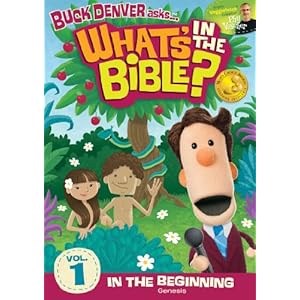
Phil Vischer presents What's in the Bible? -- A Review

     Phil Vischer of VeggieTales fame has created a new series that is loads of fun with a heavy dose of theology -- all for kids.  What's in the Bible? uses live animation and puppets to combine good, solid Bible teaching and storytelling in a quirky, silly, fun way that appeals to adults and kids alike.  These DVDs are designed to survey the entire Bible from beginning to end. Volumes 1-7, In the Beginning (Genesis) through Exile and Return (Ezra, Nehemiah, Esther), have been released so far.
     The cast of characters include:  Chuckwagon, the singing cowboy, The Sunday School Lady who is NOT as old as the OLD testament, Michael, the kid in the car watching the DVD (‎"I’ve got a question! Why are they called 'testa-mints?' Do they give you fresh breath? Because I licked one and it didn’t work." -Michael, age 8), Brother Louie, Buck Denver, 2 old ladies who remind you of the old guys on the Muppet Show, and many more.  Every character, from my understanding, is performed by Phil Vischer himself.
     Two of my favorite special segments include:  the Pirates Guide to Church History -- you know about Jesus and Billy Graham; well, the pirate fills in the stories in the middle, and the Popsicle Stick Theater -- where God is a cloud because a heart makes God look like a Valentine and fire is too scary.
    According to the very first segment on Volume 1, the Bible tells the story of God and what He's done for us, making the Bible the world's most important book.  From that point on, Phil takes two things very seriously:  teaching children Bible truths and having loads of laughs.
     Just so you can have a taste of what these videos are like, Volume 1:  In the Beginning, answers the following questions:  


*Why do Orthodox and Catholic Bibles have more books than the Protestant Bible?
*What does inspired mean?
*How can we trust the books of the Bible if we don't know who wrote them?  (Because God inspired the process AND the writing)
*How old is the Earth?  Who is right?  ("We don't know, and sometimes that's ok.  The Book of Genesis wasn't written to tell us the HOW of creation but the WHO of creation. 'In the beginning God created the heavens and the earth.'" -- Phil Vischer)
*What is sin?
*Why didn't God just change the rules so Adam and Eve could be with Him again?


     These are just a few of the questions that get answered in 25 minutes, but the real kicker is that you will hear the answers to these tough questions while giggling and cracking up at the puppet's antics.  I can't think of a better way to learn what's in the Bible, can you?


     To learn more, visit whatsinthebible.com.


Tuesday, April 17, 2012

Praise Your Children Consistently and Often: A Reminder

     When my children were young, it was so easy to lavish them with praise:
     "'Mama!'  That's right!  He's a genius!  He said 'Mama'!"
     "Oh my goodness!  What a big boy you are!  You went pee-pee in the potty!"
     "Wow!  What a great reader you are!"
     "Yes!  Three grapes plus one grape is four grapes!  You are so smart!"
     "Look at you!  You're riding your bike all by yourself!"
     "What a good sharer you are!"
     Somewhere along the line, it gets harder.  I'm not sure why, and maybe it's just me, but it gets harder.  For one, by ages 9 and 12, they are most certainly putting their pee-pee in the potty.  Furthermore, as a homeschooling mom, I'm trying hard to help my children succeed by pointing out their mistakes -- on math, grammar, spelling, writing, etc.  As a Christian mom, I want my kids to become more Christ-like by pointing out all the ways they are not acting like Christ.  Do I spend an equal amount of time pointing out when they ARE showing the fruits of the Spirit?
     The middle-school years are full of insecurity, and I need to remember to praise my boys MORE as they get older, not less.  Kids need their moms and dads to praise them sincerely for effort, hard-work, integrity, Christ-likeness, and the things they do right.  
     So, take a minute and look for a reason to praise your children today!  Make it a habit. As your children get older, don't forget it.  They need it more, not less.
     That's my prayer for today and for the future -- that I will become better at praising my boys -- consistently and often.

Tuesday, April 10, 2012

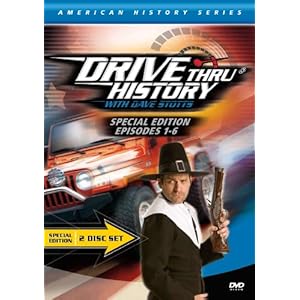
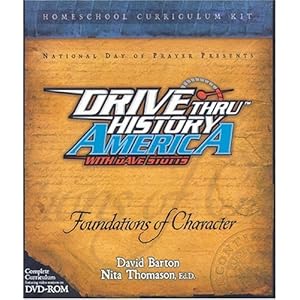
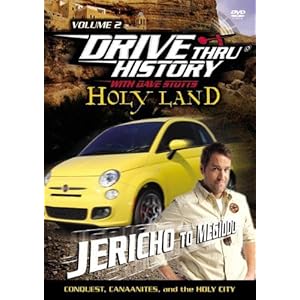
Drive thru History with Dave Stotts: History - Fast and Fun!

     The Drive Thru History series with Dave Stotts, produced by ColdWater Media, is, as the cover suggests, history - fast and fun!  Each DVD has three epidsodes that last about 30 minutes each, with the exception of the Foundations of Character series.  These quirky, often silly, videos take you on location to several important historical sites and introduce you to many historical figures, famous and not-as-famous.  Christian history is not left out and neither is the humor.  Drive Thru History is definitely educational and equally entertaining.
     This series, however, is not a history curriculum on its own.  It should be used as a supplement to the history curriculum of your choice or just for fun!  My boys and I laughed and giggled at the fake teeth, the car rolling down the hill, and the Pilgrim fashion show.  
     I recommend this series for ages 8 and up simply because some of the younger children may not get the humor.  My sons are nine and twelve, and they love these dvds.   Furthermore, if you like your children's education to be serious, don't bother buying this series!


     For more information, see www.drivethruhistory.com.  


Drive Thru History  (Ancient History)
Greece and the Word
East Meets West  (Asia Minor)
Turkish Delight
Rome If You Want To


Drive Thru History:  American History
Columbus, The Pilgrims, and Early Boston
Soldiers, Jamestown, and Heroes of Virginia
New York, New Jersey, and Washington's Warriors
Patriots, Penn, and the Freedom Trail


Drive Thru History America:  Foundations of Character  (90 minutes)


Drive Thru History:  Holy Land Series  (Brand New)


Drive Thru History is from Focus on the Family and Tyndale Entertainment.