Tuesday, March 20, 2012

Seven Lies about Homeschoolers -- A Funny Video

     This is funny because it is true.  I get asked some of the strangest questions, and some people think we are just plain weird.  Aren't we all, though?
     For the record, we do not homeschool in our pajamas, we do not finish at lunchtime, and I absolutely REFUSE to allow my children to wear pants that are too short!  I'm just sayin'.  
     However, I would love to live further from the Wal-mart and a log cabin might be cool!


Monday, March 5, 2012

Apologia Elementary/Middle School Science -- Strong Science for Ages 6-12

     Both of my boys love science.  When young, we would check out lots of books from our local library on a wide range of science topics.  However, we found that many science textbooks for the elementary and early middle school ages are weak and boring.  Fortunately, Apologia, well-known in the high school science market, now offers a science curriculum for elementary and middles schoolers that boasts strong science with a viewpoint that points to the Creator.  
     Jeannie K. Fulbright has authored six excellent books which delve into zoology, botany, astronomy, and human anatomy.  Each book contains 13 or 14 chapters and can be used for ages 6-12, with modifications, of course.  Notebooking journals are available for purchase, or you can print out pages from each course's free website.  The textbooks are full of beautiful and interesting illustrations, activities, hands-on assignments, experiments, projects, and more.  I highly recommend them because they are strong scientifically and yet Christian in viewpoint.
     Below is a list of the Apologia books and how we have or will use them.


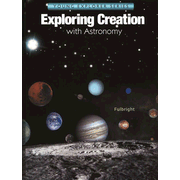
Exploring Creation with Astronomy -- When my oldest studied astronomy in 2nd or 3rd grade, I read this to him, and he created a lapbook.  We used The Usborne First Encyclopedia of Space and The World of Space by Dinah Zike and Susan Simpson in conjunction with this book.


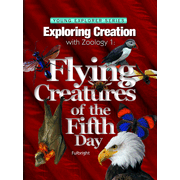
Flying creatures of the Fifth Day:  Exploring Creation with Zoology 1    After completing the Zoology 3 book in our co-op, my son read this book and the Zoology 2 book on his own at home in his 7th grade year.  He finished both books in about two and a half months.  We did not do the activities, and I did not test him.  He read for pure love of science.


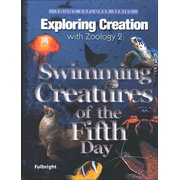
Swimming Creatures of the Fifth Day:  Exploring Creation with Zoology 2  See above.


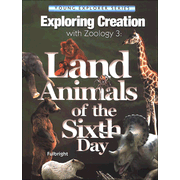
Land Animals of the Sixth Day:  Exploring Creation with Zoology 3   This book was the core textbook for the zoology class my son took at our co-op his 6th grade year.  They covered the book in a school year, covering 1 chapter every two weeks.  In my opinion, for a 6th grader, this book can be covered easily in one semester.


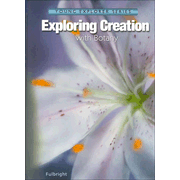
Exploring Creation with Botany  This semester, I started this book with both boys (3rd and 7th grades), and I purchased the notebooking journals that accompany the textbook.  I read a section aloud to the boys, and we work on the activities together.  Due to a busy spring, we are working slowly.  However, we built the suggested light hut and have lots of little plants growing inside waiting to be transplanted outside.  If I can ever remember to buy the appropriate flower, we will do the flower dissection!


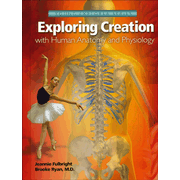
Exploring Creation with Human Anatomy and Physiology  
I hope to do this book next with both boys, right after finishing botany.  I purchased the Anatomy Notebooking Journal and the Junior Anatomy Notebooking Journal.  Had I known that the Junior version had coloring pages added in, I would not have purchased it.  If you child enjoys coloring (my third grader does not), then your child may like it.  


****NOTE:  For the month of March 2012, Apologia Elementary Science is 30% off at CBD.  This is a GREAT deal.  

Tuesday, February 21, 2012

A Day at Mullin Academy

     Recently, many people have asked me about our daily schedule.  Since today was fairly typical with no appointments or other interruptions, I decided to write everything down.  For those of you who are curious, here's a sample day at Mullin Academy.
     My goal is to start school by 9:00 a.m.  Today, we ran a bit behind.  My oldest went to Collide at our church, a youth event, where he stayed up late Friday and Saturday nights, and he was still recuperating, and my youngest and I have been battling colds.  We were all dragging this morning.  Before school begins, the boys get dressed, make beds, eat breakfast, and brush teeth.


Tuesday, February 21, 2012
9:30-12:15  School
Third grade son -- 30 minutes of independent reading, Math page 22D, sit ups, push ups, stretches (preparing for Presidential Physical Fitness challenge at our co-op), skill book (long 'a' review), shoe tying practice, spelling test 23, piano practice
Seventh grade son -- Piano practice, independent reading, read ScienceSaurus 15 minutes, grammar, creative writing homework for our co-op (writing a poem about how a pencil feels to be sharpened from the pencil's point of view -- I teach his creative writing class), reviewed 25 Latin vocabulary words
Me -- During youngest son's independent reading, I started a load of laundry, ate breakfast, tidied the kitchen, checked e-mail, and got ready for the day.  After that, I helped my youngest with the rest of his work, and  I made lunch while he practiced piano.


12:15 - 12:40  Lunch -- homemade beanie weanies, hotdogs, apples, cheese bits (My oldest ate 2 hot dogs, a bowl of beanie weanies, half an apple, and cheese bits!  Yikes!  He's only 12!)


12:40-1:00 Clean-Up Time
Youngest-- made bed (he was supposed to earlier), cleaned up Legos and Hexbugs in the living room, folded washcloths
Oldest -- unpacked Collide suitcase, got out laundry from dryer, put load from washer to dryer, sorted socks and put them away
Me -- Put a load of laundry away, folded undershirts, cleaned up table from lunch


1:00 - 2:00  Reading Time -- Everyone Together
I read to both boys in the living room.
1.  History:  A History of US:  Making Thirteen Colonies 1600-1740 by Joy Hakim, Chapter One
2.  Read Aloud:  Imprisoned in the Golden City:  Adoniram and Ann Judson by Dave and Neta Jackson  (about American missionaries to Burma in the 1800s)
3.  Science:  Exploring Creation with Botany by Jeannie K. Fulbright p. 43-44  Carnivorous Plants:  The Venus Flytrap Family and The Bladderwort Family
4.  For their spies class at our co-op, I read:   Traitor:  The Case of Benedict Arnold by Jean Fritz  p. 70-80  (We are reading the entire book aloud.  Both boys take a SPIES class at our co-op, and they are assigned two chapters a week.)


2:00  Snack and Coffee/Hot Chocolate -- because I REALLY needed coffee, and my boys are always hungry.
After snack, more school.
Youngest --  studied AWANA verses, read to mommy Third-Grade Detectives #3:  The Mystery of the Hairy Tomatoes by George E. Stanley Chapter Two (I continue to have him read aloud to me so I can check for errors or concerns.  Also, this aids fluency.), Phonics Pathways by Dolores G. Hiskes p. 184, Sheppard Software (online):  Geography -- countries of Asia and Rivers of the US (while I watched math video with oldest because I need to watch it now that he's doing pre-algebra), Basketball -- shot 45 baskets  
Oldest --  Corrected math test from yesterday, watched pre-algebra math DVD Lesson 14, did math page 14A, 10 minutes reading The Real Benedict Arnold by Jim Murphy, studied and recited Psalm 46:1-3, spelling page, Basketball -- shot 60 baskets


Third grade son finished at 3:50.
Seventh grade son finished at 4:20.


Whew!  There you have it -- that's our school day!  Questions?  Comments?  Surprised that we don't finish at lunchtime?  Feel free to tell me about YOUR homeschooling day!  

Thursday, February 9, 2012

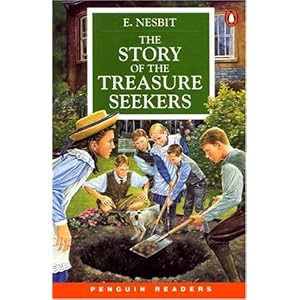
The Story of the Treasure Seekers by E. Nesbit -- A Great Read Aloud!

     "This is the story of the different ways we looked for treasure, and I think when you have read it you will see that we were not lazy about the looking."   From the first sentence of the first page, The Story of the Treasure Seekers:  Being the adventures of the Bastable children in search of a fortune, by E. Nesbit gets right to the point, and the adventures that follow are as irresistible as the Bastable children themselves.
     Originally published as short stories in magazines and put into book form in 1899, The Story of the Treasure Seekers is the delightful tale of the six Bastable children, Dora, Oswald, Dicky, Alice, Noel, and Horace Octavius (H.O.)  After their mother dies ("and if you think we don't care because I don't tell you much about her you only show that you do not understand people at all") and their father also falls ill, "his business-partner went to Spain -- and there was never much money afterwards."  As creditors start calling and the children must leave school because father can no longer afford it, they decide they must do something to restore their fallen fortunes.  Each child comes up with a plan, and, well, their plans are hysterical.  Oswald suggests stopping "people on Blackheath -- with crepe masks and horse-pistols -- and say 'Your money or your life!  Resistance is useless, we are armed to the teeth.'"  Other ideas include rescuing an old gentleman in deadly peril, using a divining-rod to search for gold, becoming bandits, finding a princess and marrying her, becoming detectives, and digging for treasure.  Fortunately for us but not so much for their father, they actually carry out their plans and much hilarity ensues.
     Written over 100 years ago, this book has never lost its appeal to readers young and old alike.  My boys were ages 11 and 8 when I read it, and we all laughed from beginning to end.  I recommend it as a read aloud because it's great fun for the entire family and because there are some vocabulary words that are difficult.  It was written in the 1890s, afterall.
     I leave you with a poem, written by Noel.  If you have a child who is sad, here in Houston, when the dead June bugs litter the sidewalks, then you'll love this poem.
     
Lines on a Dead Black Beetle that was poisoned
Beetle how I weep to see
   Thee lying on thy poor back!
It is so very sad indeed.
   You were so shiny and black.
I wish you were alive again
But Eliza says wishing it is nonsense and a shame.


     "It was a very good beetle poison, and there were hundreds of them lying dead -- but Noel only wrote a piece of poetry for one of them ...and the worst of it was he didn't know which one he'd written it to -- so Alice couldn't bury the beetle and put the lines on its grave, though she wanted to very much."     (Chapter 4)


Thanks so much, Holly S., for recommending this book!  We LOVED it!

Tuesday, February 7, 2012

100 Cupboards Trilogy by N.D. Wilson -- EXCELLENT!

     After reading N.D. Wilson's first book, Leepike Ridge, my oldest son and I sped through his three novels in the 100 Cupboards Trilogy:  The 100 Cupboards, Dandelion Fire, and The Chestnut King.  I started reading first, but by the third book, my son passed me and eagerly waited for me to finish so we could talk about the ending.  Each book grew longer (320, 480, 512 pages), but neither of us wanted to put them down.  When he finished reading at night, I asked him to leave it on the floor by his bed so I could snag it.  They were just that good.
     After his parents are kidnapped, Henry York, age 12, ends up in a town called Henry, Kansas, living with his Uncle Frank and Aunt Dotty and their three children, Penelope, Anastasia, and Henrietta, whom they also called Henry until Henry moved in with them.  One night, he finds plaster in his hair and using the knife Uncle Frank had bought for him, picks all the plaster off the wall to find 100 cupboards of all shapes and sizes, and thus begins his adventures.
     So Henry, a young, unlikely hero, who throws up when scared and whose parents made him wear a helmet to P.E. class, never told him he was adopted, and continually left him with nannies and in boarding school, finds 100 new worlds and a surprising heritage, learns to be brave, discovers baseball, family, and friendship, and, by the end, is given an impossible, Frodo-like, task.  It's a classic tale of good vs. evil, with well-developed, unique, irresistible characters and some pretty rotten, evil ones, too.  The plot keeps you guessing, and the writing is pleasantly refreshing, unique, and unexpected.   You'll find yourself holding your breath, cheering for Henry and his family, and hoping he doesn't lose everything he has just gained.  There are funny parts, intense battle scenes and fights, and loving and tender moments.  Unlike some book series which end badly as if the author didn't know how to wrap it up, this book ties up beautifully at the end, leaving you satisfied.  
     My favorite part, though, is that the boys are young, but they are loyal, keep their word, face fear, and grow as young men.  Henrietta starts out as an impulsive, sneaky girl, stubborn, and obsessively curious and turns into a brave, still-stubborn, yet strong young woman by the end.
     As a fantasy series, this is one of my favorites; it may not be The Lord of the Rings or The Chronicles of Narnia, but it is very close.  Wilson's first novel, Leepike Ridge is good, but his 100 Cupboards Trilogy is incredible.  His next series, Ashtown Burials, is out, and we can't wait to read the first book!


     N.D. Wilson wrote an article for DesiringGod.com called "Stories Are Soul Food: Don't Let Your Children Hunger" on why our children need good strong stories of good and evil, and even magic.  I wrote earlier about Wilson's father, Doug Wilson, author of Future Men, here.  (It was quite by accident and a cool coincidence that I found out that N.D. Wilson and Doug Wilson were thus related!)   For a three-chapter-sample of 100 Cupboards, click here.
     Finally, I leave you with two quotes from the last book, The Chestnut King; quotes which reveal why both my son and I loved this series.

     "Frank opened his mouth.  He wanted to make her promises, to tell her lies, but he couldn't.  Instead, he leaned his face over into her wet, straggling hair.  
     "'Dots,' he whispered.  'You're my life, and I've loved it.'  He drew in her smell, and she leaned her head against his lips.  'Every kiss, every dirty look, every night we slept between clean, starchy sheets, and every night we didn't.  Every nag and needle and nudge.'
     "He sat up.  'Your peaches,' he said.  'And your applesauce.  How many pies do you think I've eaten in my life?'  He looked down at her.  'Not enough.'  He smiled.  'If we get out of this, there needs to be more pie.  That's all the complaining I've got.'"  -- Frank to Dotty when it seems they will both die soon, The Chestnut King


     "Let evil hear the pounding of our feet!  Let evil hear our drumming and our chanting songs of war.  Let evil fear us!  Let evil flee!  In any world, may dark things know our names and fear.  May their vile skins creep and shiver at every mention of the faeren.  Let the night flee before the dawn and the darkness crowd into the shadows.  We march to war!"  -- King Nudd, The Chestnut King


Note for parents:  I recommend this series for children ages 10 and up, maybe older, depending on the sensitivity of your child.  My son is 12.  The books contain fighting and other violence, bloodshed, death, some very dark moments, and magic.  The 2nd book uses the profanity d**n. 

Friday, January 27, 2012

Homeschoolers and College -- Part 2: Tips for Parents of Middle Schoolers

     As I stated earlier, homeschoolers do, in fact, go to college.  However, getting there is a little different for homeschoolers than for traditionally-schooled students.  Therefore, I am offering tips for homeschooling parents of middle schoolers.  Beyond middle school, my personal knowledge is limited, but I am listing some resources that may offer some insight. 


     1.  Record keeping -- As a homeschool teacher in Tennessee, I was required to turn in curriculum lists and semester grades, be able to prove 180 days of instruction, and be registered with a private school or public school.  However, in Texas, such record keeping is not required.  If you have not begun to do so, in the middle school years, start keeping good records.  Make a list of curriculum and textbooks used, outside courses taken, hig school level books read, etc.  All of this will be imperative when completing college applications because many colleges require a homeschool supplement.  Take steps towards getting disciplined now or making a high school transcript will be a nightmare.  
     I use a Mead Five Star 1 subject college ruled 100 page notebook with a pocket in the front (the cover is plastic).  I write down notes daily, and I use the pocket for book lists, play programs, field trip info., etc.


     2.  Start Giving Grades -- Many homeschoolers choose not to give their children grades, and there is nothing wrong with that.  However, starting in the 6th grade, choose a course (math is easy and objective) and start testing and giving grades and give a final course grade.  For example, tests count once and semester exams count twice.  Average it all and give a final grade.  Start doing this BEFORE the grades have to show up on a transcript so your child understands how this works.  Be honest, too.  You won't do your child any favors by padding grades or giving excessive extra credit so grades look good on a transcript.  Starting early gives your child a chance to understand how testing works, and he or she can work on study skills, etc. 


     3.  Math -- Make sure your child is caught up in math and has a strong math foundation.  Even if your child does not plan to major in a field that requires math, he or she will probably have to take a college math class or two.  If your child does plan to go into a math related field and he or she is behind, work over the summer or hire a tutor.


     4.  Testing -- Starting in the middle school years, begin testing your child every other year.  I recommend the Iowa Test of Basic Skills because it is nationally normed and timed.  This will get your child used to testing (think SAT) and give you an idea of his or her weaknesses and strengths.  I tested my oldest in the 5th grade and plan to test him again in the 7th grade.


     5.  Book List -- As I said above in record keeping, start a book list of books your child has read that would count as high school reading material, whether read aloud by you or read by your child.  For example, The Lord of the Rings Trilogy or The Christmas Carol by Charles Dickens are high school level books.  Do not write down a high school level book that you read an abridged version of (unless it was Chaucer or something like that) or books where you only watched the movie version.  Keep this list in your notebook or on the computer.


     6.  Class at HEP -- Joanne Juren, veteran homeschooler and owner of the HEP Bookstore, teaches an affordable three-hour seminar called Getting Ready for High School and College every summer for parents of upcoming seventh grade or older children.  According to this year's course description, "Joanne Juren will discuss many topics pertinent to the student just entering the high school years.  Topics include: goal setting; course guidelines from 7-12th grade; the 4-year Plan; the high school transcript; extra-curricular courses and activities; job co-op; testing for high school/college; scholarships; and many more topics of interest!"  Your child can attend with you which is helpful ("Oh, Mom's not making me do this to be mean but because I really do need to") but can be overwhelming to him or her.  The amount of information crammed into three hours will leave your head spinning, but I felt it was well worth the $35 I paid for the seminar.  After a week or so, check in with your child about what he or she has heard.  My oldest son was stressed because after the class, another child told him homeschoolers can't go to college, and this really bothered him.  On the flip side, he has not complained about math one time since we took this class!  The class was offered in June last year but is offered in August this year.


     7.  Transcript -- By 8th grade, your child may be taking courses that will count as high school credit. Algebra I, Spanish I, or Earth Science are all high school classes.  Also, start planning ahead by making a tentative four-year plan for high school starting when your child is in the 7th or 8th grade.  Then take the necessary steps to make sure you are prepared to make those classes happen.  For example, if your child needs extra writing instruction or math help, try to get those areas stronger by the end of the middle school years.


     Lastly, not everyone goes to college, and that is okay.  Homeschooling offers a tremendous opportunity for students to apprentice or work within a field of interest to see if they like it.    
     For more information, HSLDA has a wealth of information on homeschooling through college on it's website.
     Also, for more information on homeschooling, see the Homeschool Progress Report 2009:  Academic Achievement and Demographics which gives some helpful insight into homeschooling in general.


Many thanks to Leesa W. for sharing so much of your knowledge with me and for recommending the HEP class.

Wednesday, January 25, 2012

Homeschoolers and College -- Part 1: Yes, College Is an Option

     "Most homeschoolers don't go to college, do they?  Won't homeschooling be a problem for college?"
     Since my son is now in the seventh grade, two different people have asked me about homeschooling and college in the last month, so I thought I'd allay any fears that anyone may have concerning homeschoolers going to college and then offer some tips for homeschooling parents.  
     Many years ago, being homeschooled limited college choices.  Universities didn't know what to do with homeschoolers who applied.  Not so anymore.  According to the HSLDA website, "Many colleges are now familiar with homeschooling in general, and most of them have already admitted homeschooled students. Some colleges even have admissions officers who specifically review homeschooled students’ applications. Record keeping is important during the high school years, so that you can provide admissions officers with an accurate account of the courses that your child has completed in high school. Most colleges require either SAT or ACT test scores for admission."
     Estimates suggest that there are approximately 2 million home educated students in grades K-12, and homeschooling is the fastest-growing education choice.  (Brian D. Ray, Ph.D., Facts on Homeschoooling).  Therefore, most universities and colleges have implemented policies for homeschooled applicants.  Google "university homeschool applicants," and you'll see what I mean.
     However, the question remains:  How do homeschoolers do in college?  Does homeschooling hinder performance?   "Can Homeschoolers Do Well in College?" on cbsnews.com had some very positive things to say about homeschoolers and their college experience.  This article, written on July 20, 2010, states  "A new study published in The Journal of College Admission suggests that homeschool students enjoy higher ACT scores, grade point averages and graduation rates compared with other college students."   Another article, "New Study Shows Homeschoolers Succeeding in College", also gives evidence that homeschooled students do well in college.
     Many home-educated students are used to educational independence by the time they are in high school.  In addition, contrary to the socialization argument, many homeschoolers  are very comfortable interacting with adults and therefore, college professors and administrators.  According to a nationwide survey released in 1997 by Dr. Irene Prue, Assistant Director of Admission of Georgia Southern University, "Homeschoolers are academically, emotionally, and socially prepared to succeed at college."  Of course, this is not the case for 100 percent of homeschooled students, and I am not advocating that all homeschoolers will definitely do well in college.  However, for the diligent homeschooled student who shows an aptitude for and desire to attend college, don't worry.  A homeschooled student can do just as well in college as a tradionally-schooled student.
     So, the answers are, "Many homeschoolers DO go to college," and "No, homeschooling (as a school choice) does not by nature hinder potential college success."  However, getting to college is different for homeschoolers.
     
To be continued... See Homeschoolers and College -- Part 2:  Tips for Parents of Middle Schoolers